
Empathy
Empathy and Compassion: The Science Behind the Feelings
How empathy and compassion are experienced, and how they can be taught.
Posted October 23, 2025 Reviewed by Margaret Foley


Key points
- Empathy often triggers compassion, which helps cement our social relationships.
- Empathy varies with gender, age, and political preference.
- Both empathy and compassion can be taught using Compassion Meditation.
In 2025, the Muhammad Ali Center published a report on compassion in the United States that revealed that 61 percent of the more than 5,000 people surveyed between 2020 and 2024 said they perceived a decline in compassion in America (the Muhammad Ali Center, 2025). The majority of us apparently see wider gulfs and taller walls between groups in our world.
The terms empathy and compassion are often used interchangeably, as if they meant the same thing, but they do not. Empathy is feeling what someone else feels—putting yourself in that other person’s position and feeling what they feel. Empathy can be the first step to compassion; being motivated to do something about what the other person is feeling, to help that person with their troubles. You can think of empathy as a trigger for compassion. Usually, we feel empathy for someone having difficulty and then feel compassion and try to help, even though compassion isn’t necessarily the next step. Empathy and compassion are essential parts of our ability to form and keep social relationships with other people.
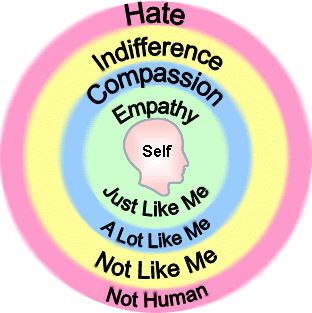
People vary in the level of empathy and compassion they feel and express. Factors like gender (women tend to be more empathetic than men), age (older people tend to be more empathetic than young people), and even political preference (liberals score higher on empathy measures than do conservatives) all influence the amount of empathy we experience (Simon-Thomas, 2017).
Other factors like our familiarity with the person we’re watching, the importance of that person to us, and what is happening to that person, and what we’ve learned about helping others can also influence the amount of empathy we feel (Preston and De Waal, 2002). Preston and De Waal proposed the Perception-Action Model (PAM) of empathy, in part to account for the similarities in empathy seen across species and nervous systems. This model proposed that seeing someone, particularly someone who is important to the observer, in an emotional state automatically activates a representation of that state in the observer. So seeing someone we know and have a relationship with in pain activates our own pain circuit in our brain. Similarities in the way pain is coded in the brain in various species account for the similarities in empathetic reactions in these species.
Tania Singer and colleagues have investigated the neurological underpinnings of empathy and the PAM model that highlights the role that empathy and compassion play in building social relationships. They asked female volunteers who were part of a relationship with another person to undergo fMRI scans in three different conditions. In one condition, the subject experienced a painful stimulus to her own hand. In the second, the painful stimulus was delivered to her relationship partner, who was in the same room as the observer. In the third condition, scans were obtained when no stimulus was delivered to either member of the pair (a no-pain condition). The women were also asked to take a questionnaire designed to measure empathy after the scans were obtained.
Not surprisingly, the researchers found that when the women experienced pain themselves, the two well-known parts of the pain circuit in the brain (the sensory component, which codes for where the painful stimulus is applied to the body, and the affective component, which codes for the emotional aspects of that pain) were activated. However, when the women watched a loved one experience pain, the affective components of the pain circuit in the anterior insula and the rostral anterior cingulate cortex were activated, but not the sensory component. In addition, the higher the score on the empathy measure, the stronger the activation of the brain.
So, an empathetic reaction to the experience of another person did not appear to involve the entire pain circuit, only the affective portion of that circuit. We feel that observed pain because our brains quite literally know what that pain feels like.

Researchers have also examined how the brain is activated by compassion. Two reviews of the literature (Kim, Cunnington and Kirby, 2020, and Novak, Malinakova, Mikoska, van Dijk and Tavel, 2022) found that compassion activated a different series of regions than did empathy. Compassion tended to activate the inferior frontal gyrus, along with regions of the insula, the anterior cingulate cortex, and the temporal gyrus.
Finally, remember that a number of factors influence our empathy and compassion. One is learning: Studies have shown that a technique known as Compassion Meditation (CM) can teach both empathy and compassion. A recent study found that four weeks of CM training increased the strength of the neural response to the suffering of others in the medial orbitofrontal cortex (a region adjacent to and strongly connected with the inferior frontal gyrus, and a part of the circuitry implicated in empathy), and the stronger the feelings of compassion generated by seeing the suffering of others was, the stronger the increase in brain response was (Ashar, Andrews-Hanna, Halifax, Dimidjan and Wager, 2021)
It is encouraging to note that we can teach people to be more empathetic and compassionate. We need it now more than ever.
References
Ashar, Y.K., Andrews-Hanna, J.R., Halifax, J., Dimidjan, S., and Wager, T.D. (2021). Effects of compassion training on brain responses to suffering others. Social Cognitive and Affective Neuroscience, 16(10),1036–1047.
Kim, J.J., Cunnington, R., and Kirby, J.N. (2020). The neurophysiological basis of compassion: An fMRI meta-analysis of compassion and its related neural processes. Neuroscience and Biobehavioral Reviews, 108, 112-123.
The Muhammad Ali Center. (2025). The 2025 compassion report. The Muhammad Ali Center. https://aliindex.org/wp-content/uploads/2025/01/The-2025-Compassion-Rep…
Novak, L., Malinakova, K., Mikoska, P., van Dijk, J.P., and Tavel, P. (2022). Neural correlates of compassion – An integrative systematic review. International Journal of Psychophysiology, 172, 46–59.
Preston, S.D. and de Waal, F.B.M. (2002). Empathy: Its ultimate and proximate bases. Behavioral and Brain Sciences, 25(1), 1-20.
Simon-Thomas, E.R. (2017, July 31). Which factors shape our empathy? greatergood.berkeley.edu/article/item/which_factors_shape_our_empathy
Singer, T., Seymour, B., O’Doherty, J., Kaube, H., Dolan, R.J., and Frith, C.D. (2004). Empathy for pain involves the affective but not sensory components of pain. Science, 303, 1157-1162.
Singer, T., and Klimecki, O.M. (2014). Empathy and Compassion. Current Biology, 24(18), R875-R878.