Parenting
Volunteering and Mental Health
Why you should give back to the community, and bring your family.
Posted July 11, 2025 Reviewed by Kaja Perina


Key points
- Research shows that volunteering can reduce mortality and increase overall functioning.
- Long-term volunteering has been associated with better mental, physical, and cognitive health in older adults.
- Volunteering can improve social capital, benefit public health, and decrease health inequalities.
- Research shows that children who volunteer are less likely to experience anxiety and behavioral problems.
Volunteering is important for the community, but it can also be beneficial for your mental health.
The benefits of serving others are astounding – research shows that volunteering can even reduce mortality and increase overall functioning. Reflecting on your experience of serving others seems to boost these effects (Nichol, B., et al., 2023). One meta-analysis revealed that regularly volunteering has positive effects on depression, life satisfaction, and wellbeing (Jenkinson, C. E., et al., 2013).
Long-term volunteer commitments have been associated with better mental, physical, and cognitive health in older adults, however, short-term volunteer experiences do not seem to boast such robust effects. Making community service a part of your lifestyle can benefit you, and your family members, in the long run (Jiang, D., et al., 2020).
Researchers suggest that volunteering ought to be promoted by public health, education, and policy advocates as an important part of a healthy lifestyle (Yeung, J. W. K., et al., 2018). On a global scale, volunteering has been advocated by the United Nations (UN), and American and European governments as a way to engage citizens in the community, improve social capital, and enjoy potential public health benefits, including decreasing health inequalities (Jenkinson, C. E., et al., 2013).
In summary, volunteering may:
- Reduce mortality
- Improve mental, physical, and cognitive health
- Combat depression
- Improve public health
- Decrease health inequalities
- Increase life satisfaction and wellbeing
Volunteering with your children will not only build a healthy habit that can contribute to their own physical and mental health benefits, research shows that children and teens who volunteer are less likely to experience anxiety and behavioral problems, and that it can even reduce feelings of social isolation which are particularly salient in adolescence. For teens, volunteering is associated with a decrease in risky health behaviors and depressive symptoms in adulthood (Lanza, K., 2023).
Family bonds can be strengthened by regularly volunteering together. In a time when few families gather around the dinner table each night, and the most common shared activity among family members is watching television, volunteering provides a meaningful way for families to connect with each other, and their community (Lewton & Nievar, 2012).
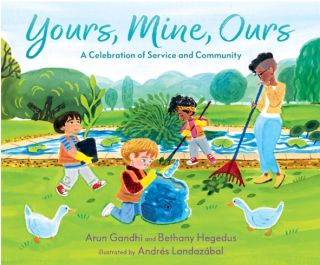
Reading picture books like Yours, Mine, Ours: A Celebration of Service and Community with young children can inspire them to come up with their own ideas about ways to give back to others through volunteering and acts of kindness. Co-authored by the late Arun Gandhi, grandchild of Mahatma Gandhi, the story imparts the value of nonviolence and service, values that parents can begin passing down to their children from the start.
References
Nichol, B., Wilson, R., Rodrigues, A., & Haighton, C. (2023). Exploring the effects of Volunteering on the social, mental, and physical Health and Well-being of volunteers: An umbrella review. VOLUNTAS: International Journal of Voluntary and Nonprofit Organizations, 35(1). https://doi.org/10.1007/s11266-023-00573-z
Jiang, D., Warner, L. M., Chong, A. M.-L., Li, T., Wolff, J. K., & Chou, K.-L. (2020). Benefits of volunteering on psychological well-being in older adulthood: evidence from a randomized controlled trial. Aging & Mental Health, 25(4), 1–9. https://doi.org/10.1080/13607863.2020.1711862
Yeung, J. W. K., Zhang, Z., & Kim, T. Y. (2018). Volunteering and health benefits in general adults: cumulative effects and forms. BMC Public Health, 18(1). https://doi.org/10.1186/s12889-017-4561-8
Jenkinson, C. E., Dickens, A. P., Jones, K., Thompson-Coon, J., Taylor, R. S., Rogers, M., Bambra, C. L., Lang, I., & Richards, S. H. (2013). Is volunteering a public health intervention? A systematic review and meta-analysis of the health and survival of volunteers. BMC Public Health, 13(1). https://doi.org/10.1186/1471-2458-13-773
Lanza, K., Hunt, E. T., Mantey, D. S., Omega-Njemnobi, O., Cristol, B., & Kelder, S. H. (2023). Volunteering, Health, and Well-being of Children and Adolescents in the United States. JAMA Network Open, 6(5), e2315980. https://doi.org/10.1001/jamanetworkopen.2023.15980
Lewton, A. R., & Nievar, M. A. (2012). Strengthening Families Through Volunteerism: Integrating Family Volunteerism and Family Life Education. Marriage & Family Review, 48(7), 689–710. https://doi.org/10.1080/01494929.2012.700909