
Philosophy
Sensing Time: A Feeling of Being Alive
As we look toward the end of life, we can stretch out our moments of pleasure.
Posted April 23, 2025 Reviewed by Davia Sills


Key points
- Time perception changes with age due to familiar experiences becoming routine.
- Salient life events become less frequent as people get older, speeding up time perception with age.
- Pleasurable experiences can stretch time, enhancing the feeling of being alive.

The world is changing. We don’t ride horses to market, we abolished slavery, and we lean on instant messaging. Today, I noticed an extraordinary change. Wikipedia, the online encyclopedia that constantly updates itself through user contributions and edits, brings to the world a wide range of topics from experts and topic aficionados.
Look up time perception on Wikipedia. You will see a textbook to study, with 9,555 words to read, including 124 citations. In time, corrections will dominate the belief-whims to get to the farthest reaches of truth. With each passing day, Wikipedia pages get longer and more precise, but we still have a long way to go before we can rely on it for proper research.
Bear with me when I say, yes, get the Wiki app and explore its contents for foot-in-the-door connections, but don’t rely on it for professional analysis. With that, consider the old question as an example: Why do we think time is speeding up with age? The familiar answer is usually that the perception of time is just the percentage of the years passed.
In this posting, I sift through 200 years of philosophizing time to bring out a simple, expert view of how to understand time. For a complete understanding, my book The Clock Mirage, which is not in one of the 124 citations on the Wikipedia site, will give a comprehensive picture of what we know about time.
A year to a 5-year-old girl would be one-fifth of her life (20 percent), while that year to a 25-year-old would seem like one-twenty-fifth (4 percent).
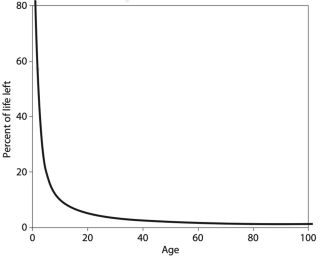
Age intervenes with the impression of time’s passing, as seen in the graph (Figure 1), but not in the way we might expect. Time awareness could have links to the proportion of one’s age.
That’s rational, but there are multiple theories of time sense. You can go wild with theories that have been coming for two centuries, starting with William James and ending with many experimenters who come up with something new every day and with more tomorrow. A different, simple way of thinking about the sense of time in each day is that, with each passing year of life, our daily experiences become more repetitive and humdrum, with fewer new ones of lasting impact. If your experiences are routine, and you pay significant attention to the salient ones—first kiss, first car, high school prom date, or a fall that chips a front tooth—time will pass quickly. The landmarks on the trails of our lives, salient experiences like those first kisses, cars, or graduations, get less frequent with age, so we think time speeds up with age, though it is not the only reason by far.
As humans, our time-senses are not subject to any single series of actions. Time-sense accelerates from intricately related inner signals that interact with the body’s understanding of how the life we lead convolutes with time. One cause is a person’s activity. The active life gives the impression that time is moving slowly, contrary to the notion that boredom makes the clock run excruciatingly slow. That activity is connected with body time, pulse, heartbeat, body temperature, muscle memory, and brain activity. Time-sense is one giant ball of interconnected feedback from how we live.
As we age, new phenomena unfold in the sense of time. Toward the end, time speeds up no matter what we do. Our bodies know age by how our cells weaken as we get older. Consider the regular body rhythms, including heartbeat, respiration, pain, temperature, and emotion, and how they contribute to a “Gestalt” for time, linked to the consciousness or unconsciousness of body rhythms and heartbeat, giving the heartbeat more credit than it deserves. Because many factors, apparent and hidden, involve brain mechanisms designed for internal cell timings that contribute to our conscious sense of time.

Figure 2 shows a simple hyperbolic curve representing human temporal impressions of time, coinciding with a curve representing the physiological time of wound healing. There could also be other hidden processes, neither psychological nor physiological, that conflagrate the presumption—a welcome thought that something more than psychology might affect our sense of time. It is no real surprise since many chemical processes follow similar geometric progressions affected by the physico-chemistry of cell life. It shows that the end of life is instrumental in why we think time speeds up with age. It is the body’s vigilant signal warning of impending death.
As we age, we become more aware that our aging cells are increasingly tired and confused about coordinated functions, such as when in the circadian cadence to turn protein building on and off. Additionally, we learn of more and more deaths, which make life seem more and more ephemeral than we once thought. Eventually, we all come to an age when the cells of our body tell us that the years seem to be going by fast and that next year will seem shorter than this one.


And there you have it, in a nutshell. Let’s all keep in mind, though, with more moments of pleasure, a bite into something delicious, a spring walk in a garden, listening to a meaningful piece of music, or perhaps just moments of deep intellectual focus, time dilates to make us feel alive.
References
Joseph Mazur, The Clock Mirage: Our Myth of Measured Time (New Haven: Yale University Press, 2020), 155-56.
Marc Wittmann, Translated by Erik Butler, Felt Time: The Psychology of How We Perceive Time (Cambridge, Massachusetts: 2016) 132-134.