
Passive-Aggression
Why People Make Passive Aggressive Comments
Passive-aggressive comments may stem from hidden anger.
Updated November 28, 2025 Reviewed by Lybi Ma


Key points
- Snarky remarks often try to invalidate, shift blame, and cop superiority.
- We all have the capacity for an occasional off remark, but motive and outcome tell us a lot.
- Brief text messages may not be passive-aggressive, we can't jump to conclusions until we know more.
I have written in a book on overcoming passive aggression that anger, triggered by other powerful emotions, resides in everyone; I advise clients to own, work through, and pass it. Hidden anger, often at the root of passive aggression, is triggered by negative emotions. This indirect and incongruent, conscious or sometimes unconscious behavior can allow people to stall, escape responsibility, deliver payback, or hurt others. This behavior may be driven by irrational anxiety or low mood, and it tends to do more harm than good—undermining relationships, careers, and personal well-being.1
People are often far more passive-aggressive when they post anonymously online. Though it’s more difficult to be so indirectly problematic in person, that doesn’t stop some. If passive-aggressive people had the skills of effective, direct, honest communication, they would not have to rely on underhanded remarks and subtle behavior.
What’s behind the insensitive remarks and actions?
“Stop being so difficult.” This demand may be relayed in frustration; it seems direct, but behind it lies projection; very likely, the utterer has posed any difficulty at hand, hence railing rather than solving the problem. Look for conflict avoidance and address it to move forward.
“I was only kidding.” This remark invalidates the other; it’s a sneaky way to hurt the other indirectly, and it evades taking responsibility. This veiled attempt to cover up the attacking words that preceded it dismisses feelings and may also stem from the perspective of one who feels entitled to do or say whatever one pleases.
“Just let it roll, you’re too sensitive.” Similar to the above, a remark like this ignores emotion while making something unreasonable accepted or normalized. While invalidating, it blame shifts.
“We’ve always done it this way.” The prevailing attitude here is an unwillingness to change; possible laziness may be behind this, but this person may be unable to adapt (which could be due to a mental health condition), or it’s merely a subtle way to insist on a norm that's in place. This may help the person escape other opinions, ideas, or expertise. Change is good for the neurons, albeit it can be tough.2
“How could you not know that?” While shoving superiority at you, anyone who uses this may be trying to patronize or cast you as less intelligent, all motives here being poor. If both the motive and outcome are good, then you may be okay with this comment; however, there are other pro-social ways to deliver this. Sometimes, a phrase like this is uttered in place of name-calling or an obvious put-down.
“I wasn’t going to say this, but…” Epitome here of the mixed message, incongruent and unnecessary. If you weren’t going to utter something or must preface this way, stop. Rephrase.
“Of course I’m fine. Why wouldn’t I be?” In any tone, this remark raises red flags of patronizing, denying anger, and mixed messaging; this may be a tip-off to passive aggression. “Why” questions are known to put others on the defensive. Conversations go downhill from that point.
Some workplaces, households, or social groups tolerate or foster a passive-aggressive culture, incentivizing indirect communication, which escapes responsibility (the old less is more).
Most people have experienced passive aggression in the workplace or the school environment. When we don’t feel free to be honest or fear retribution, resentment can set in. This only breeds passive-aggression, over time.
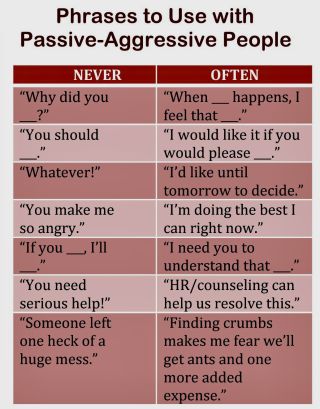
If you suspect passive aggression, you can be direct and invite others to express their feelings. If, after your best efforts, their hidden anger remains or escalates, limit exposure or interactions if possible; if not, consult the HR department or a good therapist.
Bill Eddy, author of the book It’s All Your Fault! 12 Tips for Managing People Who Blame Others for Everything, recommends that people respond to misinformation and take a position on bad behavior. You can connect, analyze, respond, and set limits.3


Phrases that get a bad rap that perhaps should not:
For future reference
Per our meeting
Friendly reminder
Circling back on this
Thanks in advance for kindly
Unless they are one’s pervasive pattern, either expression could be genuine, with pure motive and a good outcome of teamwork or information flow.
“Correct me if I’m wrong, but…” could be rephrased, “Let me know if your understanding differs from mine, which is…” It’s all in the delivery. Some with chips on their shoulders read something negative into innocent communication. Negativity is a hallmark of passive-aggression, but everyone feels negative, briefly, from time to time.
“Fine.” “K.” “Sure.” “No worries." These short text replies are sometimes seen as passive-aggressive. Unless there’s a well-known history of difficult communications, I’d respectfully disagree. Text language has always been cursory. Being brief is the point of texts. Is there a pervasive negative pattern or an impure motive? We don't know what the outcome may be, and one's overall tone before we assume short texts are terrible.
Copyright © 2025 by Loriann Oberlin, MS
References
Murphy, T., Ph.D. and Oberlin, L, MS, LCPC. Overcoming Passive-Aggression: How to Stop Hidden Anger from Spoiling Your Relationships, Career, and Happiness (New York: Hachette/DaCapo, 2016)
Appendix: Hidden Anger in the Clinical Setting; Murphy, T., Ph.D. and Oberlin, L, MS, LCPC. Overcoming Passive-Aggression: How to Stop Hidden Anger from Spoiling Your Relationships, Career, and Happiness (New York: Hachette/DaCapo, 2016)
Eddy, B. It’s All Your Fault! 12 Tips for Managing People Who Blame Others for Everything (Deerfield Beach, FL, HCI Press, 2008).