
Intelligence
Do You Need to Be a Genius to Make a Lot of Money?
The relationship between IQ and income has a few surprises.
Posted October 13, 2025 Reviewed by Hara Estroff Marano


Key points
- IQ is positively associated with income.
- To a lesser extent, IQ is positively associated with net worth.
- IQ does not protect against financial distress or going bankrupt.
- Being intelligent with money takes more than a high IQ.
It’s a simple question: Do you have to be a genius to get rich? The impact of intelligence on wealth outcomes often sparks lively debates about the importance of cleverness to financial success.
At the extremes, our minds turn to Bill Gates or Mark Zuckerberg, true geniuses who leveraged their intellect to establish ultra-successful companies. Extremely successful founders and entrepreneurs do often skew as highly intelligent. But we also intuitively understand that having a high IQ doesn’t automatically mean a red carpet path to riches is going to unfold in front of you. Factors like luck and social networks play a key role.
At a more everyday level, we have comic but perhaps all-too-real examples of intellectually suspect bosses like Michael Scott from The Office rising up the salary ranks and running the company. I’d be willing to wager that the wealthiest person you know in your social network may not be the smartest. So what does science have to say about the relationship between IQ and income?
The Relationship Between IQ and Income
To answer the question, a researcher analyzed the IQ, income, financial difficulties, and a host of relevant lifestyle variables1 of thousands of participants, all U.S. baby boomers whose information was part of a dataset called the NLSY79.
The researcher found that IQ is a strong positive predictor of earning a higher salary. To put the effect size into perspective, he found that a 1-point increase in IQ translates to a $234 to $616 increase in annual salary. The study controlled for relevant demographic factors, including race, gender, inheritance/parental wealth, and educational attainment.
The table below summarizes net worth (total assets) and annual income by IQ category.
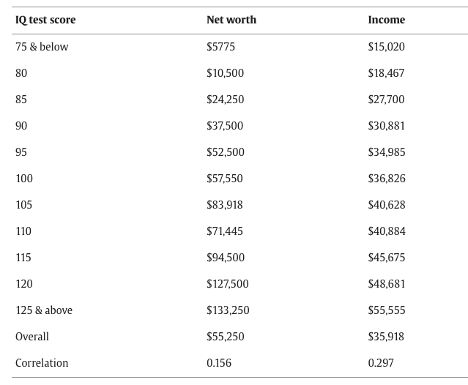
As is outlined in the table above, net worth and income increase as one’s IQ range increases. Those with IQs of 75 or less have low salaries and an even lower net worth, of approximately $6,000.. Those approaching the genius level of IQ (125+) earn annual salaries almost four times higher than those with the lowest IQ, while amassing a net worth of more than $130,000. The correlation between IQ and salary is about twice as strong as the correlation between IQ and net worth, meaning intelligence is a better predictor of income than of overall wealth.
The Relationship Between IQ and Financial Distress
The dataset also contained measures of financial hardship, including whether the participant had ever maxed out their credit card, missed a payment, or gone bankrupt. For these variables, people with slightly below average IQ had the highest frequency of financial distress.
The table below shows financial distress by IQ level. However, a more sophisticated analysis using IQ to predict financial distress but controlling for other factors finds that a higher IQ is associated with a significantly increased rate of maxing one’s credit card, missing a payment, and even declaring bankruptcy. Intelligence does not appear to buffer against making financial blunders.

Are You Doomed Financially if You Are Not a Genius?
Short answer: No! Salary and net worth are much more strongly predicted by educational attainment than by IQ. Maximizing your education, picking the right career, being consistent and hardworking in the face of adversity, living below your means consistently, and investing early and often in the stock market are battle-tested behaviors that anyone can do to start building wealth regardless of IQ.
References
Zagorsky, J. L. (2007). Do you have to be smart to be rich? The impact of IQ on wealth, income and financial distress. Intelligence, 35(5), 489-501.