
Psychoanalysis
Reflections from an American Psychoanalyst in China
What I learned in China has stuck with me throughout my career.
Posted March 10, 2021 Reviewed by Lybi Ma


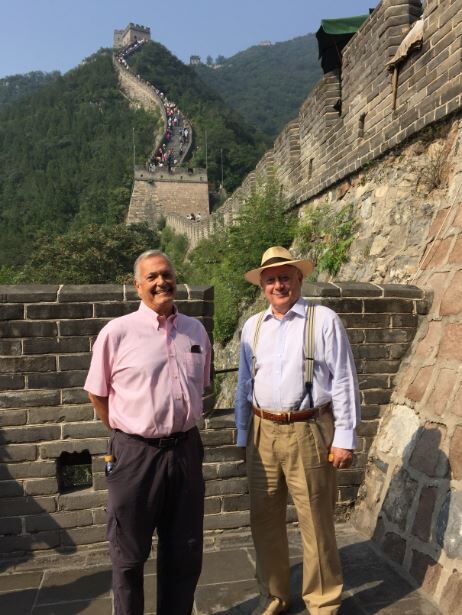
China has traditions and ways of thinking that are starkly different from those in the US. For example: while China is a country of nearly 1.4 billion, it has a young and fragmented infrastructure in the support of mental health services. And as these services develop, our Chinese colleagues want to desperately know what we know to serve their own communities.
I'm a psychiatrist and psychoanalyst who has worked in China since 2007. My Chinese colleagues want to learn what we know of psychotherapy – and I am, of course, delighted to teach them. After 14 years working and teaching in mainland China, I have come away understanding more about my culture, and myself, than I would have expected.
People often fall victim to cultural bias: seeing their own way of thinking as simply “the way things are” — though that’s never really true. (This includes many psychoanalytic ideas, such as the “truth” that individuals should strive for autonomy. In stark contrast, the Chinese stress the fit of the individual within the family and social group – a “truth” we tend to underestimate in the West.) My studies and work in China have offered me a shift in perspective that has helped me understand my own cognitive biases.
Family comes before the individual. Early on in my immersion in Chinese mental health, I heard a story from a Chinese psychoanalytic trainee, a psychologist whose patient felt that therapy would drag her away from her loyalty to her family and the connection in her community, or guanxi (关系) and towards an unwelcome individualism. He felt this same struggle applied to him in his analytic training. This taught me quite a lot about individualism as a core principle.
International policy and family structure, dynamic, have a reciprocal relationship. This is a fact that holds true in our country, as well. Our recent history of the attack on the Capitol has penetrated into the thinking of almost all of my patients, many of them fearing for the future of the democracy in which America prides itself. The future of individual and family development in China is intimately affected by all the policies, heritage, and culture of China, and in turn, the future of the family will have just as much to say about the overall future of China as will military, economic, environmental and diplomatic matters. Understanding the modern Chinese family is therefore crucial to understanding the place of China in the world of the future.
The enriching personal relationships that I have with my Chinese colleagues belie the adversarial tone in Chinese-US relations. During the Cold War years, I would see college friends learning Russian, or traveling to Russia, and think, “How could you do that? Don’t you understand they are our enemies?” I didn’t recognize it at the time, but I was deeply into my own implicit bias. Some colleagues have this idea about China, especially as diplomatic relations deteriorate, and I hear things such as: “The Chinese have so much money! Why do we teach for them either without being paid or being paid very little?”
They often also confuse ideas about the ways the Coronavirus has been treated, not only in China but on the world stage, with ideas about helping individuals and families in China directly.
Notably, we cannot effectively teach unless we also commit to learn, both from and about the cultures we step into. In being open to learning and listening, I have discovered a great deal about my own cultural ways of thinking.