
Animal Behavior
Spiders Are Smart, Not Scary
Even with very little brains, spiders can accomplish big cognitive feats.
Posted October 26, 2025 Reviewed by Gary Drevitch


Key points
- Spiders are excellent models for studies of comparative cognition and the evolution of mind and brain.
- Spider species live in diverse habitats and differ in size, sensory abilities, and foraging ecology.
- Spiders exhibit behaviors like learning, problem-solving, counting, and the ability to plan ahead.
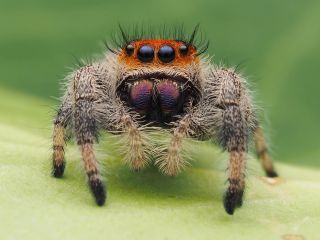
This time of year, spiders receive a lot of attention for their creepier qualities. But Ximena Nelson, a biologist at the University of Canterbury in New Zealand, appreciates spiders year-round for a different reason: their brains.
Research over the last three decades has begun to reveal the diversity and complexity of spider behavior. In addition to complex communication and signaling behavior, spiders demonstrate learning and reversal learning, significant problem-solving ability, and possibly even the ability to count.
Nelson, author of the 2024 book The Lives of Spiders, reports that there are more than 52,000 species of spiders in the world, and believes they are worth getting to know better. I talked with her about studying spider smarts in the lab and what she wants people to know about these often-misunderstood arachnids.
Q: What do spider species have in common, and in what ways do they differ?
Nelson: Let’s start with what they've got in common because it's a much shorter list. Spiders are all similar in that they're related, and they have two body parts and eight legs.
Spiders are different in a variety of ways: the number of eyes they have, their reliance on different sensory systems, their modes of respiration, their use of webs. The list just goes on and on.
Q: Why study spider cognition? What kinds of questions can you investigate using spiders?
Nelson: Some spiders show behaviors that in mammals, we would describe as cognitive behaviors. We might have a bit more trouble using the word cognitive for an animal that is the size of your fingernail. Their brains can be tiny — in jumping spiders, the brain is the size of a poppy seed. And yet they can do these amazing behavioral feats.
One of the most interesting things is that a baby jumping spider hatches fully formed. They are hunting spiders, so they search for their prey like little, tiny leopards. When they come out of the egg sac, they're after very tiny prey, because they're only about a millimeter at that stage, yet they're able to actively hunt using vision and pounce on their prey. You can hardly see the entire spiderling with the naked eye, let alone their brain. So how is it processing all that information? The brain of the young spider is so much smaller than that of the adult. They have fewer neurons, so they must be really efficient in what they do with those neurons.
In the same individual, we could measure how behaviorally complex they are when they emerge as a spiderling, rear them in the lab, and then measure them again as adults to see how much difference there is in terms of their flexibility or their ability to learn.
You could also measure between species. There are massive size differences among different species of spiders. In fact, between male and female spiders in some species, the female is a good 10 times bigger than the male.
There are all sorts of questions you can ask related to neural volume or brain size, and comparisons that you can make within individuals, within species, between species in the same group, or between species in different groups.
Q: There is some research suggesting that spiders have the ability to plan ahead. What is the evidence for this?
Nelson: My former advisor did some experiments in the late 1990s with Portia — which is like the Einstein of jumping spiders. Portia was able to see something at a distance, lose sight of the prey, and then approach it from behind, suggesting planning behavior. I've seen this in the field and I've seen it in the lab, and it certainly looks like planning. But it’s difficult to test. We're currently running some experiments, but I don't have the data yet.
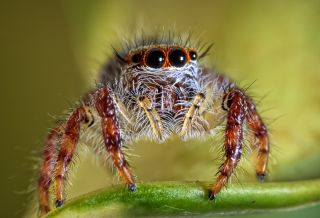
Previously, I’ve run experiments using a water maze. Jumping spiders don't like water at all. I put them on an island in an arena surrounded by water with four ways to exit. They have to jump onto smaller islands to get out, essentially. The four exits differ in the number of jumps and how risky those jumps are. There is one safe option and three risky options. But the key difference in this experiment is that the first jump is the same for all four exits, and it's a big, risky jump. If they choose the safe option more than 25% of the time, that suggests that they assessed all four options and opted for the safe option. And we found evidence that they do plan ahead in that scenario.


Q: Do spiders show individual differences in cognition?
Nelson: There are definitely differences. Some spiders are, well, pathologically stupid, I'm tempted to say, and some are really clever and motivated. With jumping spiders, we tend to use females because the males as a group are just not motivated for cognitive experiments. I'm sure that they'd be great for sexual selection studies, but for cognition studies, they are just no good at all.
We expect there to be variation in ability and behavioral traits between individuals, and we do see consistent individual differences. With some spiders, I have to say, I’m not testing you, I've given up on you, I'm just going to take you back to the field.
Q: How do spiders demonstrate behavioral flexibility or learning, even in the context of innate behaviors?
Nelson: Spiders in general have a lot of innate behaviors. Jumping spiders are innately capable of executing the correct sequence of behaviors to hunt their prey. Web building spiders are innately capable of building their webs. But all spiders learn: The web gets better and the hunting gets better as they practice. So even innate behaviors can improve with experience.

The interesting thing is that web-building spiderlings create very tiny webs that are exactly the same pattern as the larger webs they build as adults. Those spiders must perform a lot of fine motor skills, requiring a lot of coordination with eight legs. And they've got to do the correct sequence of what type of silk to put where because they use different types of silk for different parts of the web. It's thousands and thousands of steps. Yet the spiderling can do that. It really shows how much complexity can be encoded in innate behavior.
But if I were to snip a little strand, the spider or spiderling would detect that immediately and fix it. It would be able to repair its web because it detects that there's a problem. So there is flexibility, as well.
Q: What kinds of questions about spider cognition remain?
Nelson: There's a lot of interesting work that could be done with comparative approaches. For example, most spiders are generalist predators. But some are specialists and hunt dangerous prey like other spiders or ants, both of which can kill. They need quite specific predatory behaviors to be able to hunt that prey. The jumping spider Portia fimbriata, for instance, hunts other jumping spiders—prey with very good vision that can see Portia coming—and so it's very tricky in how it hunts. You could look at closely related species that have different hunting techniques and see whether the specialists are trickier than the generalists.
You could also potentially rear spiders in the lab and then break up the sibling groups and raise some with a lot of habitat enrichment and others in a basic habitat or provide one group with access to really nutritious prey and others access to non-nutritious prey. You could do this within a species, but then across species, as well. There is so much that you could study in terms of the role of experience in shaping cognition, as well as the role of genes because you can look at siblings. It's not something you can do with a herd of elephants.
Q: What do you wish people knew about spiders?
Nelson: If you ever encounter a spider, they're much more afraid of you than you are of them. I mean, consider the size difference for a start. Pause and think rather than immediately blaming the spider or fearing the spider, because the spider's scared of you.
Also, spiders get unfairly blamed for a lot of bites. Unless you actually see the spider bite you and you've collected it, chances are it was something else, like a scratch or a mite, tick, or mosquito. Most spiders can't even pierce human skin.
And if you did get bitten by a spider, it was likely a defensive bite because you rolled over on it or you put your foot on its house. So suddenly it's getting squashed and it's going to defend itself the only way it can.
Q: What has been your favorite spider species to work with?
Nelson: One that I most enjoyed working with was a jumping spider called Servaea incana that lives under the bark of a specific species of eucalyptus tree in eastern Australia. It was just like a little tank, and very chilled out and easy to work with. It was motivated to complete experiments and just generally a nice, mellow spider.
The other one that comes to mind is an ant-eating specialist I used to work with called Chalcotropis. It is big, about 13 millimeters, which is huge for a jumping spider, and almost as wide as it is long. So it really was like a tank with little, short legs. I think I like my chunky spiders!
References
Nelson, X. J. (2025). Cognition in spiders: Small brains on eight legs gain traction. Journal of Zoology, 326(2), 93–108. Doi: 10.1111/jzo.70030.