
Diet
Skinks Avoid Danger by Eavesdropping on Bird Alarm Calls
Inter-species eavesdropping allows skinks to live beside their predators.
Posted June 17, 2020 Reviewed by Gary Drevitch


The Kalahari region of southern Africa is home to a sparrow-sized bird called the sociable weaver (Philetairus socius). These birds might be common, but their lifestyle and nest-building skills make them extraordinary.
Sociable weavers create huge nesting structures that, from a distance, resemble haystacks hanging in trees. But underneath, one can see the entrances to different chambers within the nest. A single weaver colony nest can contain hundreds of nesting chambers, providing homes for more than 100 weaver families. The nests are used by multiple generations of birds and can last for decades.

Weaver colonies also host a wide range of other species, including African pygmy falcons (Polihierax semitorquatus). Pygmy falcons do not build their own nests, instead relying on weaver colonies for pre-made homes.
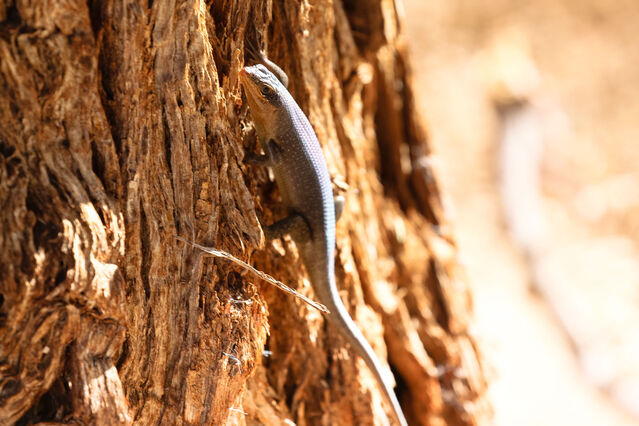
Another animal that associates with sociable weavers is the Kalahari tree skink (Trachylepsis spilogaster). Benefits to the skinks include increased refuge, basking, and foraging opportunities. However, there is a downside to hanging out near weaver colonies: The diet of the pygmy falcon largely consists of small lizards, including skinks.
Anthony Lowney, a Ph.D. student at the FitzPatrick Institute of African Ornithology at the University of Cape Town, wondered how the skinks manage living next door to their predators.
Lowney says that although falcons do not often prey on adult weavers, weavers produce alarm calls when a falcon is visible and disperse when they approach. Along with Tom Flower and Robert Thomson, Lowney conducted observational and experimental tests to see if skinks eavesdrop on sociable weavers for hints about the whereabouts of falcons. The results were published in the journal Behavioral Ecology.
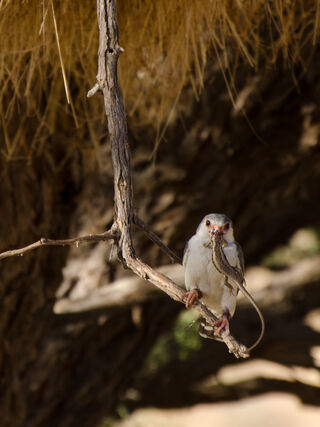
The researchers’ observations showed that skinks use information from weavers to determine when predators are nearby.
“If weavers are present and relaxed, skinks can use this as a sign that it is unlikely that pygmy falcons are nearby and that the skink can take risks,” says Lowney. “They can bask in the open and forage further away from refuge.”
Lowney and his colleagues also found that playing weaver alarm calls caused skinks to increase their vigilance and flee to safety in the trees, especially skinks that lived with sociable weavers as compared to skinks caught at trees without a weaver colony.
Together, the evidence suggests that eavesdropping on weavers provides skinks with an early warning signal of potential predators, allowing them to live side-by-side with pygmy falcons.
In his Ph.D. thesis, Lowney is investigating the importance of sociable weaver colonies to the surrounding animal community. He has found that many different species use weaver colonies for different reasons, creating local biodiversity hotspots, especially as environmental conditions become drier.
“Multiple bird species use the chambers to roost at night, while others also use them for breeding,” he says. “Larger birds, including owls, will build their nests on top of the colonies, while terrestrial animals will use the shade created by larger structures to escape the sun. Cheetahs climb on top to use the platforms as lookouts and leopards occasionally leave their kills on top.”
With all this activity, and likely more yet to be discovered, Lowney believes structures such as weaver colonies could also serve as hubs of information sharing between species. Inter-species eavesdropping is likely an important resource that allows animals to locate food and avoid predators – and is probably more common than we think.
References
Lowney AM, Flower TP, and Thomson RL. Kalahari skinks eavesdrop on sociable weavers to manage predation by pygmy falcons and expand their realized niche. (2020). Behavioral Ecology, araa057, Doi: 10.1093/beheco/araa057.