
Marriage
Ant Colonies Have Specialized First Responders
Ants that specialize in rescuing colony mates inherit the job from dad.
Posted April 13, 2020 Reviewed by Lybi Ma


In colonies of certain social insects, such as ants, individuals are specialized for particular jobs. For instance, different ants can be responsible for foraging, brood care, nest maintenance, waste management, and defense of the colony.
Recent advances in genetics have shown that these task specializations are heritable. How does that work in a colony where only the queen produces offspring? The answer is polyandry, in which a queen mates with multiple males. Polyandry could be a strategy for introducing genetic diversity into the colony and thereby generating heritable jobs.
That’s how it works in colonies of Cataglyphis cursor, a Mediterranean desert-dwelling ant. Queens leave the nest briefly to mate with nearby males. These multiple matings produce an average of 10 different patrilines, groups of half-siblings that have different fathers but the same mother. They also create the foundation for heritable behavioral specializations.
In a small number of ant species, including C. cursor, there are some individuals with a unique specialization: They are rescuers, an ant version of first responders. Their job is to free trapped nestmates. These ants can easily get caught by collapsing sand and debris in the sandy soils on which they live. When a trapped ant calls for help using a chemical signal, rescuers respond by systematically excavating around the victim and gently tugging on its exposed body parts.
Importantly, not all individuals help out this way. Instead, some ants immediately move away from the victim, clearing a path for the rescuers to do their work.
Karen Hollis of Mount Holyoke College, in collaboration with Elise Nowbahari of the University of Paris, first documented this rescue behavior about ten years ago. In a recent paper published in the Journal of Experimental Biology, Jason Andras, also of Mount Holyoke College, together with Nowbahari, Hollis and their students set out to see whether C. cursor rescuers are genetically specialized for their jobs.
“Two lines of research hinted at a heritable basis,” she says. “In one, we looked for evidence of learning in two different species of ants but found none in either species. In another, we were studying the [development] of rescue behavior and those data suggested that rescue not only emerged very early but also that ‘once a rescuer, always a rescuer.’”
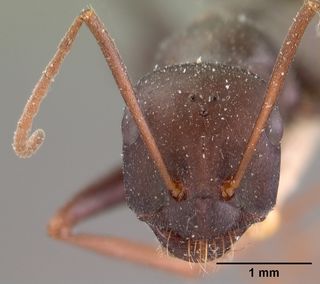
In the new study, Hollis and her colleagues first identified rescuers and non-rescuers from C. cursor colonies. Next, using polymorphic microsatellite markers, the researchers determined the paternity of each of the individuals.
The results showed that rescue behavior is heritable, with 34 percent of the variation explained by paternity. In addition, a follow-up experiment, in which the researchers marked individual ants as they emerged from their cocoons and then tested them over their first 20 days, revealed that this specialization emerges as early as five days of age and the frequency of rescuers remains constant across ants’ age ranges.
“Taken together, the results of our genetic and developmental analyses clearly demonstrate that aiding victims in distress is heritable in this ant,” Hollis and her colleagues write in the paper.
Still, Hollis and her colleagues have further questions about this behavior. They are continuing to explore the nature of the chemical signal that these ants use to call for help. And future research may explore the forces that govern the frequency of rescue behavior within and among ant colonies and answer the question, why don’t all workers rescue?
References
Andras JP, Hollis KL, Carter KA, Couldwell G, and Nowbahari E. 2020. Analysis of ants’ rescue behavior reveals heritable specialization for first responders. Journal of Experimental Biology 223: jeb212530. Doi: 10.1242/jeb.212530.