


The task: find an object that you are visually familiar with, such as your keys, by rummaging around with your hand in your bag. For humans, it’s a piece of cake. You can easily recognize, through touch alone, something you’ve previously seen.
This ability to experience an object in one sensory modality and later recognize it in another is called cross-modal object recognition. It’s actually a highly complex cognitive capacity that was thought to be limited to vertebrates. Cross-modal object recognition has been demonstrated across vision and touch in humans, apes, monkeys, and rats; across vision and hearing in dolphins; and across vision and electric sense in the weakly electric elephantnose fish. Whether the ability is widespread throughout the animal kingdom has been debated.
Now, a group of researchers from Queen Mary University of London and Macquarie University in Australia show that bumble bees are capable of performing this task.
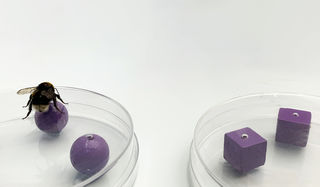
In a study published in the journal Science, researchers trained bumble bees to differentiate two differently shaped objects (cubes and spheres) using only touch (in a darkened room) or only vision (in a lighted room but where they could not touch the objects).
After training, the researchers tested the bees to see if they could identify the same objects using only the other sense. They discovered that after learning to discriminate objects by using only one sense, bumble bees can discriminate these same objects by using a different sense.
“It’s been argued that insects are not very intelligent beings,” says Selene Gutierrez Al-Khudhairy, one of the study’s authors. “They can be thought of as robots, simply reacting to stimuli they come across.”
Bumble bee brains have fewer than one million neurons, while human brains may contain as many as 100 billion neurons. In addition to having fewer neurons, tiny invertebrates like bees have brain structures that differ greatly from those of vertebrates. Yet, this study shows the bumble bee is capable of what was previously thought to be a highly complex cognitive capacity.
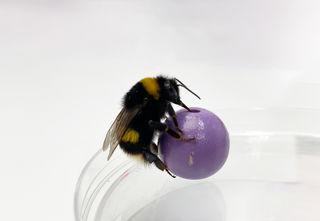
The fact that bees are capable of cross-modal recognition might have implications for how we think about cognition and even sentience. In humans, scientists assume this ability involves mental imagery based on internal representations in higher brain centers. Mental imagery involves an internal representation that is not only available to awareness but is a basic building block and an integral part of consciousness.
The results of this study suggest that bumble bees can create mental images of objects using information garnered from multiple senses and form sophisticated mental representations of their external world. Whether this translates to some kind of awareness or sentience is still up for debate.
“We cannot know for certain what a bee is thinking,” says Al-Khudhairy. “But we do know that they have the capability to transfer information from one sense to another sense. This requires the ability to picture something in one’s head.”
Al-Khudhairy and her coauthors hope their research broadens the way people look at insects, especially when so many of them are threatened or endangered.
“I hope it changes the way we think of insects, whether it’s their welfare or conservation. Bumble bees and other bee species are really struggling right now. If people care a bit more, it could help their situation.”
References
Solvi C, Al-Khudhairy SG, and Chittka L. (2020). Bumble bees display cross-modal object recognition between visual and tactile senses. Science 367(6480): 910-912. Doi: 10.1126/science.aay8064.