
Ketamine
Ketamine Use Disorder Is on the Rise
Ketamine can be addicting: Here's what you need to know.
Updated November 9, 2024 Reviewed by Margaret Foley


Key points
- Ketamine use disorder/ketamine addiction is being recognized as an emerging addictive disorder.
- Ketamine, an essential medicine according to WHO, has health and addiction risks in recreational use.
- Ketamine use disorder diagnostic questions have been proposed and can be used by clinicians and users.
Increasing numbers of ketamine users are asking if they may be addicted to ketamine. The answer often is yes. We don’t yet know how widespread ketamine use disorder (KUD) is. Still, the internet is full of accounts of people becoming addicted to ketamine taken at clubs, home, or recreationally as an alternative to cocaine or other drugs they fear might be adulterated with fentanyl. Ketamine addictions are also reported by people taking ketamine off-label for depression or anxiety, who assumed they were safe because a doctor prescribed their ketamine.
Ketamine Hallucinations
Ketamine users need more ketamine to obtain the same effect, and they also report “K cramps,” severe abdominal pain in classic withdrawal symptoms of addiction. Most users experience brief but terrifying hallucinations described as vivid, dream-like experiences distorting vision and sound, sensory perceptions, time, and space. Ketamine produces out-of-body dissociative experiences, causing feelings of disconnectedness, which may be perceived as observing themselves from afar. Intense euphoric or unsettling feelings may accompany hallucinations. The hallucinations typically last 30 to 60 minutes when introduced intravenously or intramuscularly, though effects can linger one to two hours or longer. After the peak, users may feel disoriented, with effects gradually diminishing.
Ketamine Users in the U.S.
In the United States, ketamine is most commonly used by teens and young adults of higher socioeconomic status, often polydrug-using adults. Ketamine is frequently used recreationally at clubs, music festivals, and raves. Some illegal ketamine use starts as “self-medication” for depression, anxiety, or trauma.
Death and Ketamine
It is well-known that actor Matthew Perry died from ketamine overdose in 2023. However, how many others died of ketamine overdoses is unknown. In one 2023 study, researchers reported 312 ketamine overdose cases, including 138 deaths. In death reports and overdose cases, ketamine was the primary drug in 89.1 percent and 79 percent of cases, respectively. But we don't have CDC data to track ketamine data as we do fentanyl overdoses.
The DEA indicates ketamine seizures have been increasing. Ketamine is often smuggled into the U.S. from Mexico, China, and other countries, where it is more easily accessible or produced illegally. The DEA also tracks online and dark web ketamine sales. Overall, the DEA’s ketamine seizures at borders and ports of entry show increases in illicit use and trafficking of ketamine, prompting heightened enforcement efforts. For example, on September 12, 2024, DEA officers discovered an unclaimed suitcase containing 34 pounds of ketamine at Dulles Airport, intercepted in transit from Amsterdam. Officers identified eight pouches of ketamine with a street value of about $900,000.
Ketamine Addiction in the United Kingdom and Australia
The number of people seeking treatment for ketamine addiction in the United Kingdom doubled between 2019 and 2023, from 1,140 to 2,211. The proportion of young people receiving substance misuse treatment with ketamine problems increased from under 1 percent in 2015 to 6 percent in 2023. Others were treated for Ketamine-Induced Cystitis.
U.K. psychiatrist Owen Bowden-Jones, M.D., in the Guardian, concluded, “My sense is the vast majority are using it to self-medicate for emotional distress," noting that this may reflect difficulties in accessing mental health services. Bowden-Jones added, “Young people are using different drugs to what our services are expert in. Many young people wouldn’t dream of using heroin; it’s obvious in their minds that’s a hazardous, highly addictive drug to start on, and yet they’re coming to me using two to three grams of ketamine a day.” In the U.S., as well, ketamine is often not considered addicting by physicians and users. However, one key reason for this post is to report ketamine is addicting .
Australian use of fentanyl, alcohol, and cocaine has decreased, while November 2024 wastewater data has shown that ketamine use is at an all-time high. The report’s 531 samples were taken from wastewater treatment plants to non-intrusively detect drugs in the form they were taken or in a known metabolite. The burgeoning presence of ketamine – especially among people in their 20s and 30s – was driven by availability and gone from being diverted from pharmaceutical supplies to being manufactured under clandestine conditions. Seizures of the drug had risen alongside its use.
Ketamine Addiction Risks
New research indicates ketamine’s reinforcing effects are related to set, setting, and other factors, making ketamine more addicting.
1. Dose: Self-administration of ketamine increases at higher doses. Unlike drugs like cocaine, intermittent exposure to higher doses of ketamine is more dangerous than continuous exposure. Dose, intermittent use, and route are essential, with intravenous and intramuscular the most likely to cause addiction.


2. Stress: Chronic stress enhances self-administration and makes ketamine more rewarding. Ketamine’s anti-anxiety or even bizarre dissociative effects may be perceived as rewarding under stress.
3. Substance Use Disorders: Prior exposure to other addictive substances (like cocaine or opioids) increases ketamine self-administration, probably due to cross-sensitization. Ketamine is an NMDA receptor antagonist, and drugs like dextromethorphan, alcohol, benzodiazepines, and opioids acting on NDMA receptors can change ketamine’s effects and increase addiction liability.
Ketamine Use Disorder

Linda Cottler, Ph.D., and her fellow researchers at the University of Florida have shown that KUD can be reliably diagnosed. Their research highlights compulsive ketamine use, marked by tolerance, withdrawal, and persistent desire to cut down despite adverse consequences.
I asked Dr. Cottler why she is studying KUD now, and she says researchers have been ascertaining issues involved with ketamine and what determines potential addiction. Cottler’s research aims to ensure diagnostic frameworks are reliable across various substances, including ketamine, and are applicable in diverse cultural contexts.
Her work suggests ketamine would likely be most addicting to people with a prior history of a substance use disorder (SUD).
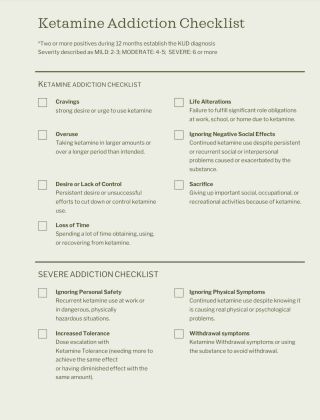
Here is a diagnostic symptom checklist for ketamine addiction where only two or more positives indicate KUD:
1. Craving or strong desire or urge to use ketamine.
2. Taking ketamine in larger amounts or over a longer period than intended.
3. Persistent desire or unsuccessful efforts to cut down or control ketamine use.
4. Spending a lot of time obtaining, using, or recovering from ketamine.
5. Failure to fulfill significant role obligations at work, school, or home due to ketamine.
6. Continued ketamine use despite persistent or recurrent social or interpersonal problems caused or exacerbated by the substance.
7. Giving up important social, occupational, or recreational activities because of ketamine.
8. Recurrent ketamine use in dangerous and physically hazardous situations.
9. Continued ketamine use despite knowing it causes physical or psychological problems.
10. Ketamine tolerance (needing more to achieve the same effect or having diminished effect with the same amount).
11. Ketamine withdrawal symptoms or using the substance to avoid withdrawal.updownedit
Ketamine and Psychiatry
Pioneering researcher and Yale Psychiatry Chairman John Krystal, M.D., said, “We started testing ketamine and depression almost 30 years ago. Certain groups of people may not be fit for ketamine therapy, including people with a history of drug abuse, people vulnerable to developing or that have schizophrenia, and people who have manic depressive illness, also known as bipolar disorder.”
However, some clinician-experts argue against a complete prohibition against ketamine use in SUD patients. For example, Arwen Podesta, M.D., president of the Louisiana Psychiatric Medical Association (LPMA) argues, “Patients with addiction, whether active or in treatment, often have complicated stories, with co-morbidities, which sometimes includes suicidality and/or PTSD.”

Podesta adds, “There is a risk of every medication, but our job as prescribers and treaters, especially of the most complicated patient, is to add safeties and guardrails. Treating with ketamine is no different.”
Conclusion
Concerns about risks involving the illicit use of ketamine, overdose, and addiction have increased as supply and users have increased. The legal U.S. ketamine clinic industry of infusion clinics is growing and is expected to top $6.90 billion in revenue by 2030, according to Grandview Research. Polydrug use and SUDs increase ketamine’s addiction liability. Ketamine driving problems, as well as psychosis, distortions of reality, and addictions, are often reasons users wonder if they should stop using ketamine. Ketamine use disorder is a real problem and an increasingly common reason to seek help. There is an absolute lack of research into the treatment of ketamine use disorder. Addiction should be considered a risk of ketamine use, and users should be questioned whether they have ketamine use disorder.
References
Fitzgerald ND, Striley CW, Palamar JJ, Copeland J, Kurtz S, Cottler LB. Test-retest reliability and cross-cultural applicability of DSM-5 adopted diagnostic criteria for ketamine use disorders. Drug Alcohol Depend. 2021 Nov 1;228:109056. doi: 10.1016/j.drugalcdep.2021.109056. Epub 2021 Sep 21. PMID: 34592704; PMCID: PMC8678918.
Palamar JJ, Wilkinson ST, Carr TH, Rutherford C, Cottler LB. Trends in Illicit Ketamine Seizures in the US From 2017 to 2022. JAMA Psychiatry. 2023;80(7):750–751. doi:10.1001/jamapsychiatry.2023.1423
Chaves TV, Wilffert B, Sanchez ZM. Overdoses and deaths related to the use of ketamine and its analogues: a systematic review. Am J Drug Alcohol Abuse. 2023 Mar 4;49(2):141-150. doi: 10.1080/00952990.2022.2132506. Epub 2022 Nov 21. PMID: 36410032.
Chu PS, Ma WK, Wong SC, Chu RW, Cheng CH, Wong S, Tse JM, Lau FL, Yiu MK, Man CW. The destruction of the lower urinary tract by ketamine abuse: a new syndrome? BJU Int. 2008 Dec;102(11):1616-22. doi: 10.1111/j.1464-410X.2008.07920.x. Epub 2008 Aug 1. PMID: 18680495.
Anderson DJ, Zhou J, Cao D, McDonald M, Guenther M, Hasoon J, Viswanath O, Kaye AD, Urits I. Ketamine-Induced Cystitis: A Comprehensive Review of the Urologic Effects of This Psychoactive Drug. Health Psychol Res. 2022 Sep 15;10(3):38247. doi: 10.52965/001c.38247. PMID: 36118982; PMCID: PMC9476224.
Roberts E, Sanderson E, Guerrini I. The Pharmacological Management of Ketamine Use Disorder: A Systematic Review. J Addict Med. 2024 Sep-Oct 01;18(5):574-579. doi: 10.1097/ADM.0000000000001340. Epub 2024 Jun 26. PMID: 38922637.



