Our Irrational, Anthropomorphic Urges
Why we rescue toys, cling to cubes, and fall in love with luggage.
By Justin Gregg Ph.D. published September 2, 2025 - last reviewed on September 11, 2025


One morning back in the late 1990s, I was walking through the back streets of Drogheda, Ireland. The alleyways were strewn with litter. Amid the detritus, I spotted a tiny stuffed monkey, a casualty from the discarded McDonald’s Happy Meal that lay nearby. I hurried to catch my train to Dublin but spent the rest of the day thinking about this monkey. Its beady little plastic eyes had been staring up at me as I walked by, and I felt sad that I had left it among the street garbage.
By the time I made it back to Drogheda that evening, I was overcome with a feeling that I needed to rescue the little monkey. I found him exactly where I had last seen him. Nobody had bothered to pick him up, which made my heart bleed for him all the more. I brought him home to my wife and explained what had happened, which did not surprise her at all. I am known to have a soft spot for stuffed animals. We ran the monkey through the washer, and he came out looking good as new. He was given the moniker Laundry Monkey and had the honor of sitting on a shelf above our washing machine—the patron saint of dirty things waiting to be made clean again.
I am not crazy. I know that this monkey is just a bunch of fabric and plastic and does not have any capacity to feel sad at being abandoned on a street. And I know that the empathy swelling in my chest when I first saw it was generated by psychological mechanisms in my brain that create a sometimes irrational anthropomorphic response. I know this. I know this on a professional level, for crying out loud. And yet, I still treated that little hunk of fabric and plastic tenderly. So what is going on here?
Laundry Monkey was triggering an empathic response in me that made me act as if it had thoughts and feelings, an internal mental life that I needed to respond to. I didn’t want him to be sad, so I took him home. Clearly, these triggers were happening below the level of consciousness; I hadn’t reasoned my way into this bonkers position. Even when I consciously ruminated on the irrationality of these feelings, I still seemed unable to stop myself from feeling them. I had anthropomorphized Laundry Monkey.
An Irrational, Universal Instinct
Anthropomorphism is the human propensity to treat a nonhuman entity in a way you’d normally treat another human—even though you know it is not a human. This famously includes animals, but also objects like Laundry Monkey, natural events like hurricanes, abstract concepts like corporations, and computer software like AI. To treat something as a human means to interact with it in a manner that assumes it has a human-like mind, even in cases where, like Laundry Monkey, there is no chance that it could. Despite this irrational stance, anthropomorphism is a universally observed behavior, part and parcel of the human condition across cultures and throughout history.
The battle between scientists over the use of anthropomorphism as a tool for understanding animal minds has been raging since Darwin’s time. Throughout my training as an animal cognition scientist, anthropomorphism was a dirty word, a potential pitfall that could fool us into thinking animals had human-like cognitive traits where none were to be found.
The Eyes Are the Mirror of the Soulless
It’s vital to understand that anthropomorphism is an invisible, involuntary process that partially operates below the level of rational thought. We don’t need to consciously believe the thing we’re anthropomorphizing actually has an inner mental life identical to a human’s for our minds to nudge us to treat it like a human. This is why it crops up as often for objects as for animals.
Three primary triggers—eyes, movement, and language—are responsible for the bulk of our anthropomorphizing.
We are hardwired to notice eyes, and have cognitive systems that oblige us to search for faces and eyes in our environment. Why? Aside from revealing the location of a predator or prey species (which is handy info), noticing a pair of eyes in the wild could indicate the presence of a fellow human with whom we might form a social connection. Once such a connection is established, eyes convey vast quantities of information about the other person’s inner mental life.
Because my human brain is hypersensitive to the presence of eyes in my environment, even Laundry Monkey’s beady little plastic ones were enough to trigger my anthropomorphism.
Our propensity to look for eyes and faces in our environment and use that information to read intentions and internal mental states is what leads to face pareidolia—an illusion caused by looking at ambiguous stimuli and having our minds force meaning onto them. Thanks to face pareidolia, humans are predisposed to having our minds trick us into seeing a face whenever we come across stimuli that bear even a vague resemblance to two eyes and a mouth. So unstoppable is face pareidolia that when we see fruits and vegetables with googly eyes or fake teeth glued onto them, we perceive the produce as humanish beings that laugh, cry, or otherwise express emotions they 100 percent do not have.
Moved by Movement
Movement is another trigger for anthropomorphism. We consider anything that moves of its own accord (self-propulsion) as having goals and intentions stemming from a mind similar to ours—a predisposition that manifests in infancy. The more humanish the movements, the more triggered we are to believe they are being controlled by an actual human mind. This is especially true if that movement is random or unpredictable.
In a famous experiment from 1944, psychologists Fritz Heider and Marianne Simmel showed people a brief animation with three geometric shapes—a large triangle, a small triangle, and a circle—and a box with an opening. The shapes moved around the screen, bumping into each other, and going in and out of the box. After viewing the video, people were asked to describe what they saw. Instead of saying things like, “The large triangle first was in the box and then moved out, and then the circle moved into the box,” they framed the video as a narrative: “The large triangle is a bully and was acting aggressively toward the small triangle and circle. They had to run away and hide from the mean triangle. He was probably jealous.” Thanks to subconscious anthropomorphism triggers, people couldn’t help but view the shapes as having intentions and emotions—simply because their movements were happening in a humanish way, with sudden, unpredictable changes in direction and variations in speed.
Movement speed, it turns out, is another anthropomorphism trigger. Had the shapes in the Heider-Simmel illusion been moving at a far greater speed, the illusion would have been shattered. Animals or things that move faster or slower than a typical human are less likely to trigger anthropomorphism. This is known as the timescale bias.
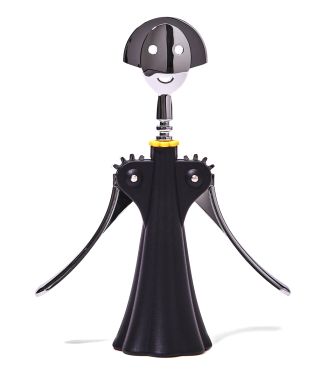
Finally, if a nonhuman thing appears to be trying to communicate in a way that suggests that they have the capacity for human language, our brains will be primed to start interacting with that thing as if it were in fact a fellow human.
You might assume that at least one of these major anthropomorphism triggers would have to be present for us to anthropomorphize an object. But the crazy thing is that we sometimes detect intentions even when there are no physical triggers whatsoever.
The Companion Cube
In my favorite video game, Portal, an AI named GLaDOS (Genetic Lifeform and Disk Operating System) has forced you (the player) to solve a bunch of complicated puzzles involving teleporting around a series of test chambers at the fictional Aperture science testing facility. For one level, the game designers created a puzzle in which the player was supposed to carry a giant metal box from the start of the level all the way to the end and use it along the way to solve some of these puzzles. But when they first unveiled this level to game testers, they found that people kept forgetting to take the box with them.
While researching ways to manipulate the psychology of the players to remind them to take the box along, one game designer, Erik Wolpaw, found a government document on interrogation techniques that suggested that “isolation leads subjects to begin to attach to inanimate objects.” This inspired another game designer, Kim Swift, to find a way for the player to form an attachment to the metal box. Her solution was simple: She painted a heart on its side and renamed it the Weighted Companion Cube. When the player first finds Companion Cube, it’s accompanied by an instructional graphic depicting someone affectionately cradling it in their arms. GLaDOS then tells the player, “This Weighted Companion Cube will accompany you through the test chamber. Please take care of it.”
“After that, no one ever forgot the box,” Swift says.
Later in the game, the designers had to find a way for the player to learn to use an incineration device that would be needed when fighting the final boss. Their solution was to have the player practice by incinerating the cube. After the player arrives at the end of the testing level, GLaDOS says, “The Weighted Companion Cube certainly brought you good luck. However, it cannot accompany you for the rest of the test, and unfortunately must be euthanized.” A pit in the ground then opens up, and the player is meant to throw their Companion Cube friend into the fire. “Although the euthanizing process is remarkably painful,” explains GLaDOS, “eight out of ten Aperture science engineers believe that the Companion Cube is most likely incapable of feeling much pain.”
The idea of incinerating the nominally sentient cube was too much for some players. In testing, some people refused to do it. “A couple of them jumped into the incinerator themselves rather than kill the cube,” Swift noted. Thankfully, Companion Cube makes an appearance at the end of the game, much to the relief of those of us who struggled with the idea of killing our friend. Companion Cube would go on to become the most loved character in Portal, spawning all sorts of merchandise, including, of course, a Sexy Companion Cube Halloween costume.
Consider how bizarre this is: Companion Cube contains exactly zero anthropomorphism triggers. There’s nothing humanish about it. It doesn’t make cute sounds. It doesn’t move. It is just a metal box with a heart on it that someone told you is your friend. How does the cube nonetheless elicit an anthropomorphism response? The answer is: The player wants to anthropomorphize it. It’s fun. There is pleasure to be had in pretending that nonhuman things have humanish qualities. We allow ourselves to feel anthropomorphism toward the cube because it pleases us. Mind-to-mind interaction is what made our species so successful, so it’s not strange that natural selection designed our brains to derive pleasure from the process. We enjoy it so much that we allow ourselves to do it even when we know that those minds are obviously absent.
The Anthropo-Dial
To better understand how this works, I need to introduce you to a concept I call the Anthropo-Dial. Imagine it as a little dial in your brain that controls the intensity with which you anthropomorphize something. The dial has settings ranging from Not Human (we don’t treat the thing like a human in any way) to Fully Human (we treat the thing as if it were another human with a mind identical to our own) and a spectrum of settings in between that indicate varying degrees of human-like treatment.
Each time our mind encounters a trigger, it turns the Anthropo-Dial up a few notches, making it more likely we will anthropomorphize the thing doing the triggering. But crucially, each of us can consciously decide to move our Anthropo-Dial. We can choose to anthropomorphize Companion Cube because it would be more fun if we did, thus we crank up the dial a bit. Turning the dial overrides the default settings, making it easier to engage in anthropomorphizing and experience the fun of pretending that a metal cube has feelings. It’s an illusion we actively allow our minds to generate.

The Anthropo-Dial helps explain both why we can treat things as if they are humanish even though we don’t truly believe they are anything like a human and why we can treat things as if they are not humanish even though we might believe they are fairly humanish. Surely, plenty of slaughterhouse workers have pets at home, and they can crank their dial right back up when interacting with their favorite cat. This helps explain our seeming cognitive dissonance in anthropomorphism for inanimate objects.
For pretend play, children can turn their Anthropo-Dial way up in order to experience the pleasure of interacting with their hobbyhorse, Star Wars action figure, or Barbie doll as if the toys had humanish feelings. But they never seem to tick over into actually believing that these things are real humans. This is thanks to what I call the Humanity-Limiter, a psychological buffer created by your mind that ensures you reap the benefits/pleasures of treating a nonhuman thing similarly to a fellow human but never risk deluding yourself into believing that the thing is human. The Limiter is there to stop people like me from actually believing that Laundry Monkey has the same mind and moral value as my wife.
The Downside of Anthropomorphizing
Anthropomorphizing objects isn’t always a good thing. It occasionally leads to pathology. Objectophilia (also called objectum sexuality or object sexuality) describes people who “experience a range of emotional, romantic and/or sexual attractions to objects, often forgoing or dispensing with human romantic or sexual intimacy.” It is a rare disorder that can involve all sorts of objects.
Rain Gordon, a Russian woman, has had a long-term relationship with a silver metal briefcase she named Gideon. She found it in a hardware store in 2015 and slowly fell in love with it over the course of a few weeks, eventually “marrying” Gideon in 2020.
Objectophilia has been part of Gordon’s life from the age of 8. “I knew that it was wrong and beyond the norms of society. I didn’t tell anyone,” she has explained. It’s clear from her description of her life with Gideon that Gordon believes the briefcase has a human-like mind and is capable of communicating with her and reciprocating her love. She does not appear to view the relationship as pretend play. “Our spiritual connection and communication is shown telepathically....I hear him, and he hears me, but from the outside it looks like a monologue. His moral support helps me more than anyone else. Sometimes I feel like Gideon knows me better than I do.”
Gordon’s story strikes many people as bizarre only because she seems blind to what Gideon really is: a thing that cannot possibly have a humanish mind. And yet, on the surface, her behavior is quite similar to how many of us treat the objects in our lives that are important to us: a guitar, a boat, or Laundry Monkey.
Still, even in such extreme cases, it’s not clear that anthropomorphizing objects is necessarily a problem. Objectophilia doesn’t always negatively affect people’s quality of life. “Almost all of the objectum sexuals [OS] surveyed expressed satisfaction with their orientation to objects,” concluded sexologist Amy Marsh in her study of the condition. “For most OS people, unhappiness and stress come from lack of understanding and human interference with their object relationships.”
Anthropomorphizing objects is a universal phenomenon. It arises from the same kind of anthropomorphism triggers we find in both other humans and animals. And we take pleasure in it; it’s fun to pretend that the objects in our lives or the anthropomorphic characters in our stories are humanish, although not fully human. Living in a world that seems more predictable—more human in that it’s loaded with objects that have pseudo-intentions—appears to make us happier and less anxious, even if we know, deep down, that we’re just pretending.
Justin Gregg, Ph.D., is a Senior Research Associate with the Dolphin Communication Project and an Adjunct Professor at St. Francis Xavier University, where he lectures on animal behavior and cognition. He is the author of Humanish and If Nietzsche Were a Narwhal.
From the book HUMANISH: What Talking to Your Cat or Naming Your Car Reveals About the Uniquely Human Need to Humanize by Justin Gregg. Copyright © 2025 by Justin Gregg. Reprinted by permission of Little, Brown and Company, a division of Hachette Book Group Inc., New York, NY. All rights reserved.
Submit your response to this story to letters@psychologytoday.com.
Pick up a copy of Psychology Today on newsstands now or subscribe to read the rest of this issue.

