
Awe
A Lunar Eclipse and the Power of Awe
Encountering truth, gratitude, inspiration, and the intangible.
Updated September 10, 2025 Reviewed by Davia Sills


Key points
- Awe interrupts rigid patterns of thought and opens space for new perspectives.
- Experiencing awe strengthens psychological resilience through gratitude and connection.
- Everyday moments of awe—such as kindness, laughter, or insight—can be as powerful as rare events.
- Awe helps us embrace uncertainty and move forward with greater openness and meaning.
For Jeanne-Clare and Ash
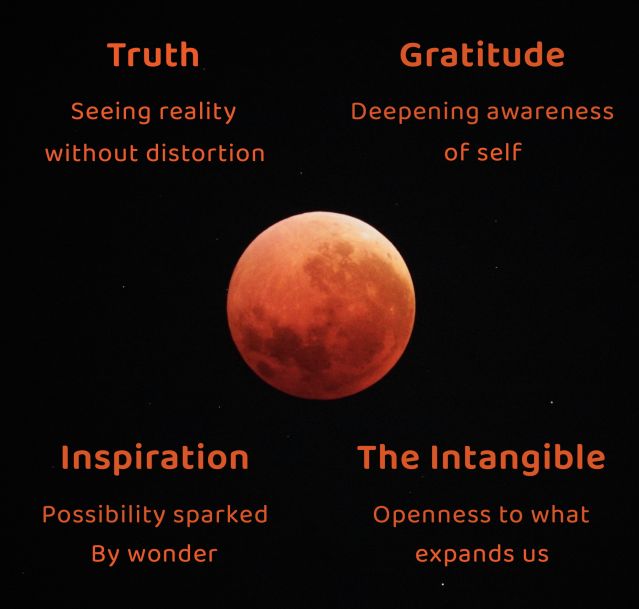
Wonder is the curiosity or openness that appears when we encounter something unexpected, whereas awe is the felt response to vastness or depth—something that humbles us and heightens our awareness. During the recent lunar eclipse, I experienced both. I stood outside with my camera as I captured the moon slowly shifting from silver into a deep, copper-red glow.
While the transformation was taking place, I thought about something Joseph Campbell wrote: “Awe is what moves us forward” (Osbon, 1995, p. 20). That simple phrase inspired me to reflect on the nature of awe itself, and I began to consider the qualities that give it its power. Four came to mind with particular clarity: truth, gratitude, inspiration, and the intangible.
Awe and Truth
Awe connects us to truth by cutting through distortion. Much of human suffering stems from stories we tell ourselves—narratives of inadequacy, judgment, or fear that cloud our perception. Awe interrupts those stories. When we stand before something vast and undeniable—whether a lunar eclipse, a mountain range, or a moment of profound human kindness—our defensive filters fall away. We are confronted not with our projections but with what is.
In therapy, I notice this when someone finally names their experience without embellishment or self-criticism. Saying, “I feel lonely” without immediately adding “and that makes me weak” is a moment of awe in its own right. It is a moment of truth, connecting us with reality in its raw form, and in doing so, it allows healing to start.
Awe and Gratitude
Awe naturally evokes gratitude. Standing beneath the eclipse, I was aware not only of the beauty of the event but also of the privilege of being alive to witness it. Gratitude shifts attention away from scarcity towards wholeness. Gratitude strengthens resilience, deepens relationships, and broadens perspective (Emmons & McCullough, 2003; Wood et al., 2010).
When clients in therapy begin to frame their lives through gratitude, even in small ways, their relationship with struggle changes, and they become more self-aware. Gratitude does not deny pain, but it allows joy and hardship to coexist. Awe creates these openings for gratitude by drawing us out of narrow concerns and into a wider view of life’s gifts.
Awe and Inspiration
Awe sparks the imagination. For me, the eclipse was more than a spectacle of shadow and light; it stirred reflections about cycles, new beginnings, and hidden phases in life, reminding me that inspiration marks the shift from feeling stuck to recognizing possibilities. It is the realization that life offers more options than are currently visible.
I often notice inspiration emerge in therapy when someone suddenly glimpses a path forward—a way to reframe their story, a new possibility for connection, or an idea about the future. These sparks may seem small, but they often become turning points. Awe fosters this sense of inspiration by lifting us out of the ordinary and showing us that change is possible (Chirico & Yaden, 2018).
Awe and the Intangible
Perhaps the most defining feature of awe is its intangibility. No photograph I took that night could capture the atmosphere of stillness, the awareness that others across the globe were also looking skyward, or the sense that something ancient was unfolding. This is the mystery of awe: It always leaves something unsaid, something beyond our ability to pin down.


Psychologically, this is important because it expands our tolerance for uncertainty—much of human anxiety centers around the need for certainty and control. Awe, by contrast, humbles us into accepting that not everything can be explained or managed. Mystery is not a threat but a part of life that deepens our understanding. It reminds us that not everything can be explained or controlled, and that learning to live with ambiguity builds resilience (Valdesolo & Graham, 2014).
Awe in Daily Life
Although the lunar eclipse was a striking catalyst, awe is not limited to rare celestial events. It is present in everyday life if we allow ourselves to notice: in a child’s laughter, in an unexpected act of kindness, in a moment of silence between conversations. These daily experiences of awe are just as significant because they invite us to pause and see things from a different perspective.
In my clinical work, I notice awe appearing in the quiet moments of realization. A client links two parts of their story and suddenly sees themselves differently. A group discussion shifts from focusing only on problems to recognizing strengths that had previously gone unnoticed. These moments may be brief, but their impact endures. Awe broadens the perspective, enabling people to see more of themselves and more of life.
Awe as Eclipse
An eclipse is a temporary shadowing of light. The moon doesn’t disappear, but our view of it changes. Awe works in the same way. It eclipses our usual habits of judgment, certainty, and repetition just enough for us to see things differently. In that interruption, self-awareness emerges.
Growth often requires these pauses—moments when the ordinary is disrupted, prompting us to see with fresh eyes. Awe does not eliminate difficulty, but it places it within a wider perspective. Just as the shadow made the moon oddly beautiful, awe can turn our own shadows into viewpoints that inspire us to move forward.
Belonging to Something Greater
The lunar eclipse reminded me that awe keeps us grounded in truth, fosters gratitude, ignites inspiration, and helps us stay open to the intangible. These qualities together create a way of being that resists rigidity and encourages growth.
Campbell was right: Awe is what moves us forward (Osbon, 1995, p. 20). It doesn’t provide us with certainty or simple answers. Instead, it broadens the questions we ask and eases the boundaries of what we believe we know.
Living with awe is recognizing that we are part of nature, not separate from it—participants in a story much larger than ourselves.
References
Chirico, A., & Yaden, D. B. (2018). Awe: A self-transcendent and sometimes transformative emotion. In H. C. Lench (Ed.), The Function of Emotions: When and Why Emotions Help Us (pp. 221–233). Springer International Publishing.
Emmons, R. A., & McCullough, M. E. (2003). Counting blessings versus burdens: An experimental investigation of gratitude and subjective well-being in daily life. Journal of Personality and Social Psychology, 84(2), 377–389.
Osbon, D. K. (1995). A Joseph Campbell Companion: Reflections on the Art of Living. Harper Perennial.
Valdesolo, P., & Graham, J. (2014). Awe, uncertainty, and agency detection. Psychological Science, 25(1), 170–178.
Wood, A. M., Froh, J. J., & Geraghty, A. W. A. (2010). Gratitude and well-being: A review and theoretical integration. Clinical Psychology Review, 30(7), 890–905.