Support Groups in YO11
I'm setting up a support group for those struggling with illness and/or disability. The charge will depend on how many are interested in coming. Ring to register your interest and put your name down
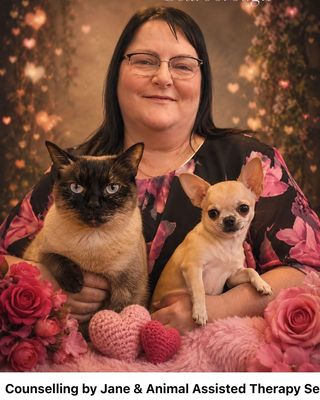
Hosted by Counselling by Jane & Animal Assisted Therapy
Counsellor, MBACP Accred
Group meets in Scarborough YO11
I'm setting up a support group for those struggling with illness and/or disability. The charge will depend on how many are interested in coming. Ring to register your interest and put your name down
Spend time with the therapy cats and dogs. Enjoy stroking them, brushing them and playing with them. Relax and talk with a cat on your knee.
Hosted by Counselling by Jane & Animal Assisted Therapy
Counsellor, MBACP Accred
Group meets in Scarborough YO11
Spend time with the therapy cats and dogs. Enjoy stroking them, brushing them and playing with them. Relax and talk with a cat on your knee.
I offer supervision to therapists individually. £60 for one hour, £75 for an hour and a half. Group supervision £30 each per session. Supervision of Supervision available (price same as supervision rate).
Hosted by Counselling by Jane & Animal Assisted Therapy
Counsellor, MBACP Accred
Group meets in Scarborough YO11
I offer supervision to therapists individually. £60 for one hour, £75 for an hour and a half. Group supervision £30 each per session. Supervision of Supervision available (price same as supervision rate).
Online Groups
If you’re looking for long-term, weekly therapy to work through current difficulties, build social confidence and better understand yourself and others this analytic therapy group might be a good choice for you. You will be able to commit to regular attendance, in person. Sessions will take place in Bolton, Greater Manchester. Please contact me for details and to book a free, initial consultation.

If you’re looking for long-term, weekly therapy to work through current difficulties, build social confidence and better understand yourself and others this analytic therapy group might be a good choice for you. You will be able to commit to regular attendance, in person. Sessions will take place in Bolton, Greater Manchester. Please contact me for details and to book a free, initial consultation.
Losing a baby through Miscarriage can be a very distressing, Frightening and lonely experience. Perhaps you would like to meet with others women and men who have also lost a baby in early pregnancy. Nottingham Miscarriage support aims to provide a safe environment in which men and women experiencing the grief of losing a pregnancy, can come together to share their experiences and provide each other with mutual support.

Losing a baby through Miscarriage can be a very distressing, Frightening and lonely experience. Perhaps you would like to meet with others women and men who have also lost a baby in early pregnancy. Nottingham Miscarriage support aims to provide a safe environment in which men and women experiencing the grief of losing a pregnancy, can come together to share their experiences and provide each other with mutual support.
Many people find surviving in groups difficult - this includes family, friend, professional ,work and other life groups.We are born into groups and continue in our lives involved or part of social groups.For some individual being in a group is difficult and lonely - as being able to understand and communicate effectively in social groups is a vital part of our daily life.Sometimes we do not have the skills to negotiate the group for many different reasons.This group is for those who want to change and experience in a safe space being part of a group

Many people find surviving in groups difficult - this includes family, friend, professional ,work and other life groups.We are born into groups and continue in our lives involved or part of social groups.For some individual being in a group is difficult and lonely - as being able to understand and communicate effectively in social groups is a vital part of our daily life.Sometimes we do not have the skills to negotiate the group for many different reasons.This group is for those who want to change and experience in a safe space being part of a group
This therapy group is open to adults of all ages and deals with a wide range of challenges. Group Analysis focuses on developing working relationships within the group to enable understanding and change. Group Analysis is based on the understanding that the underlying causes of difficulties are linked with your past and present social environment and experiences. This is best addressed in a group, where the relationships between the members themselves can help in understanding the difficulties you face in the rest of your life.

This therapy group is open to adults of all ages and deals with a wide range of challenges. Group Analysis focuses on developing working relationships within the group to enable understanding and change. Group Analysis is based on the understanding that the underlying causes of difficulties are linked with your past and present social environment and experiences. This is best addressed in a group, where the relationships between the members themselves can help in understanding the difficulties you face in the rest of your life.
I offer schema therapy which explores early life experiences and childhood unmet need, this therapy is helpful for those whom have been experiences emotional dysregulation, engaging in unhelpful relationships and struggling to manage life without anxiety

I offer schema therapy which explores early life experiences and childhood unmet need, this therapy is helpful for those whom have been experiences emotional dysregulation, engaging in unhelpful relationships and struggling to manage life without anxiety
This is a safe space for women who are in their postnatal period who may be experiencing social isolation, low mood and anxiety, confidence and self-esteem issues, and/or putting a lot of pressure or having unrealistically high expectations of themselves. This is a safe space to work together using CBT techniques to help manage these symptoms and share your stories with other women experiencing these difficulties too.

This is a safe space for women who are in their postnatal period who may be experiencing social isolation, low mood and anxiety, confidence and self-esteem issues, and/or putting a lot of pressure or having unrealistically high expectations of themselves. This is a safe space to work together using CBT techniques to help manage these symptoms and share your stories with other women experiencing these difficulties too.
Awaken to our true nature through mindful practice

Awaken to our true nature through mindful practice
Miscarriages are difficult. It can impact your body, your emotions and it might be a topic you want to avoid. But they're actually fairly common - in fact, one in four women will suffer from a miscarriage in their lifetime. Whether it's your first, your second or your fifth, know the paths to recovery will vary, as do our personalities, our support networks, and our preparedness. The first step is recognizing the physical and psychological fallout of a miscarriage.

Miscarriages are difficult. It can impact your body, your emotions and it might be a topic you want to avoid. But they're actually fairly common - in fact, one in four women will suffer from a miscarriage in their lifetime. Whether it's your first, your second or your fifth, know the paths to recovery will vary, as do our personalities, our support networks, and our preparedness. The first step is recognizing the physical and psychological fallout of a miscarriage.
The Imago Couple two day workshop offers you a distraction free space to focus on you and/or your relationship where you will learn effective new communication skills that will lead to more: safety, connection, empathy, compassion & understanding in your relationship.

Hosted by CBT Therapy Manchester (Individuals & Couples)
Psychotherapist, MA, MBABCP
Group meets in Manchester M25
The Imago Couple two day workshop offers you a distraction free space to focus on you and/or your relationship where you will learn effective new communication skills that will lead to more: safety, connection, empathy, compassion & understanding in your relationship.
I am offering low-cost group therapy sessions to help to process the current changes via Zoom and if later on possible from the clinic. The fear of getting sick, protecting or losing a loved one. Worry about your income or job, or your next carrier move. During isolation feeling claustrophobic and alone or panicky. Normally we are not spending so much time together with our family or partner it can be hard to get along. keep sane and motivated during these difficult times.
I am offering low-cost group therapy sessions to help to process the current changes via Zoom and if later on possible from the clinic. The fear of getting sick, protecting or losing a loved one. Worry about your income or job, or your next carrier move. During isolation feeling claustrophobic and alone or panicky. Normally we are not spending so much time together with our family or partner it can be hard to get along. keep sane and motivated during these difficult times.
A group of up to five, using group as a medium for supervision for counsellors, psychotherapists and psychologists, including students.

A group of up to five, using group as a medium for supervision for counsellors, psychotherapists and psychologists, including students.
A group supporting people who are developing their recovery from addiction and dependence issues utilising Group therapy. Using the systemic approach and the A2R proven methods.

A group supporting people who are developing their recovery from addiction and dependence issues utilising Group therapy. Using the systemic approach and the A2R proven methods.
This group is based on an evidence based model of working with parents of children who struggle with anxiety. We currently have a pilot running with Chorlton based primary schools, which is free to access. We are also accepting referrals for an independent group that will have spaces parents can pay for themselves. It is a great group for parents who would like to learn more about supporting their children to overcome anxious experiences and develop resilience. Parents of children who are experiencing anxiety, OCD, separation anxiety, difficulties attending school and other anxiety related difficulties would benefit from this group.

Hosted by Altogether Human CIC - Dr Gemma Parker
Psychologist, HCPC - Clin. Psych.
Group meets in Manchester M21
This group is based on an evidence based model of working with parents of children who struggle with anxiety. We currently have a pilot running with Chorlton based primary schools, which is free to access. We are also accepting referrals for an independent group that will have spaces parents can pay for themselves. It is a great group for parents who would like to learn more about supporting their children to overcome anxious experiences and develop resilience. Parents of children who are experiencing anxiety, OCD, separation anxiety, difficulties attending school and other anxiety related difficulties would benefit from this group.
I am an experienced counsellor who practices with a Humanistic & Integrative approach. This means I will focus on the needs of you, using techniques from different areas. Each person is unique and therefore I do not feel I am the expert of you and can tell you what to do, my belief is to support and guide you to with my experience to help you work through your concerns

I am an experienced counsellor who practices with a Humanistic & Integrative approach. This means I will focus on the needs of you, using techniques from different areas. Each person is unique and therefore I do not feel I am the expert of you and can tell you what to do, my belief is to support and guide you to with my experience to help you work through your concerns
**Ignore location this group is online** Binge eating thrives in isolation. During these times of social distancing you may be struggling more than ever with your relationship with food. The aim of the group is to bring together people who are struggling with binge eating/overeating. Group work can be a very powerful tool to reduce the shame that often surrounds this issue. The group can provide a space for you to increase your awareness about how you relate to food and help you to understand what is keeping you stuck.

**Ignore location this group is online** Binge eating thrives in isolation. During these times of social distancing you may be struggling more than ever with your relationship with food. The aim of the group is to bring together people who are struggling with binge eating/overeating. Group work can be a very powerful tool to reduce the shame that often surrounds this issue. The group can provide a space for you to increase your awareness about how you relate to food and help you to understand what is keeping you stuck.
This is an online Group session

This is an online Group session
A free to attend, online therapeutic group for women of colour. A monthly space to meet in a semi-formal group setting to share life stories, discover more about yourself, learn from and empower each other. We meet the last Wednesday of every month. Just drop me a line to join.
A free to attend, online therapeutic group for women of colour. A monthly space to meet in a semi-formal group setting to share life stories, discover more about yourself, learn from and empower each other. We meet the last Wednesday of every month. Just drop me a line to join.
See more therapy options for YO11

FAQs - About Group Therapy and Support Groups
How can I find a support group in YO11?
To find a support group in your area, start by entering your city, postcode, or the name of the group into the search bar at the top of the page. When searching, consider whether you prefer an in-person or virtual group. This can help you decide how broad your geographic search should be. If you are open to virtual groups, you might want to search by state instead of just your city, especially if there are limited options nearby.
Once you complete your search, you can use the filters to narrow the results by selecting specialties (such as grief, trauma, or eating disorders), therapeutic approaches, age groups, and other criteria to find a group that best fits your needs.
Once you complete your search, you can use the filters to narrow the results by selecting specialties (such as grief, trauma, or eating disorders), therapeutic approaches, age groups, and other criteria to find a group that best fits your needs.
How does group therapy work?
Group therapy is led by one or more trained therapists and provides a space where participants can process their experiences and learn from others facing similar challenges. Groups may focus on a specific issue—such as addiction, grief, physical illnesses, parenting, or caregiving—or they may center around a particular therapeutic approach, such as Cognitive Behavioural Therapy (CBT), social skill development, or Exposure Therapy. Some groups are also designed for specific populations, such as teens, veterans, or LGBTQ+ individuals.
It’s also important to distinguish group therapy from peer-led support groups, like Alcoholics Anonymous. While both can offer valuable support, therapy groups are typically led by licensed professionals and follow a more structured format. Therapy groups often meet for a fixed length of time with a consistent group of members, while many peer support groups meet for an indefinite period of time with members coming and going.
It’s also important to distinguish group therapy from peer-led support groups, like Alcoholics Anonymous. While both can offer valuable support, therapy groups are typically led by licensed professionals and follow a more structured format. Therapy groups often meet for a fixed length of time with a consistent group of members, while many peer support groups meet for an indefinite period of time with members coming and going.
What are the benefits of group therapy?
Group therapy offers several important benefits. It brings together people facing similar challenges—whether related to mental health, physical health, or life transitions—and creates a supportive environment where participants can exchange feedback, share experiences, and learn from one another. Hearing different perspectives can help individuals discover new coping strategies and practical tools they may not have encountered on their own. Sharing personal experiences, such as coping with a serious illness or navigating family struggles, can also reduce feelings of isolation and foster a sense of connection and understanding. In addition to emotional support, group members often gain useful, real-world advice from peers who have faced similar situations.
Group therapy is typically more affordable than individual therapy and, for certain conditions, can be equally effective. Many groups also include structured activities—such as guided journaling, cognitive-behavioural exercises, or role-playing—to help participants develop concrete skills they can apply in daily life.
Group therapy is typically more affordable than individual therapy and, for certain conditions, can be equally effective. Many groups also include structured activities—such as guided journaling, cognitive-behavioural exercises, or role-playing—to help participants develop concrete skills they can apply in daily life.
Is group therapy as effective as individual therapy?
It is difficult to make a blanket statement about the effectiveness of support groups, as they vary widely in focus and the conditions they address. However, support groups can be highly valuable in helping individuals gain emotional support and achieve meaningful treatment outcomes. For certain conditions, such as substance use, research has shown that group therapy can be particularly effective—sometimes just as effective as individual therapy—in supporting long-term recovery.
Many professionals attribute the effectiveness of group therapy to the unique benefits of the group setting, which fosters peer-to-peer learning and a sense of connection through shared experiences. Group settings also offer accountability and encouragement from both facilitators and fellow participants, which helps sustain motivation and supports continued progress. These factors together play a key role in promoting the overall effectiveness of group therapy.
Many professionals attribute the effectiveness of group therapy to the unique benefits of the group setting, which fosters peer-to-peer learning and a sense of connection through shared experiences. Group settings also offer accountability and encouragement from both facilitators and fellow participants, which helps sustain motivation and supports continued progress. These factors together play a key role in promoting the overall effectiveness of group therapy.
How much does group therapy cost?
Group therapy is typically less expensive than individual therapy, with sessions typically costing between £45 to £60 each. In comparison, individual therapy can cost anywhere from £60 to £150 or more per session, even with insurance. Some therapists or organizations offer low-cost or free group therapy options, particularly through community centers or non-profit organizations. In some cases, groups may require payment upfront for a set number of sessions, such as paying for six weekly sessions at the first meeting. However, many providers offer payment plans to help make participation more accessible if this upfront payment is required.
Does insurance cover group therapy?
If you have private insurance, your plan may cover some if not all of your group therapy sessions. You should contact your insurance provider to determine if they provide coverage for group therapy sessions and to determine what, if any, requirements they might have in order for your sessions to be covered, such as a referral from your GP or medical specialist.
How long does group therapy last?
The length of each group therapy session typically ranges from 45 minutes to two hours, depending on the therapy approach, the group’s goals, and how often the group meets. In some cases, group therapy is part of a larger treatment program, such as an Intensive Outpatient Program (IOP), where group sessions complement individual therapy and are scheduled as part of the program’s overall structure.
The duration of participation in a group also varies. Some groups are designed to be short-term, lasting anywhere from 6 to 24 weeks—for example, bereavement groups or skills-based groups like those using Dialectical Behavioural Therapy (DBT). Other groups may be longer-term, lasting a year or more, and some ongoing support groups meet indefinitely, allowing participants to stay as long as they find the group helpful.
The duration of participation in a group also varies. Some groups are designed to be short-term, lasting anywhere from 6 to 24 weeks—for example, bereavement groups or skills-based groups like those using Dialectical Behavioural Therapy (DBT). Other groups may be longer-term, lasting a year or more, and some ongoing support groups meet indefinitely, allowing participants to stay as long as they find the group helpful.
What are the limitations of support groups?
Support groups offer many benefits, but they also have certain limitations. Unlike therapy groups, many support groups do not provide formal therapeutic treatment and are not led by licensed mental health professionals. For individuals seeking clinical treatment for specific mental health diagnoses—such as depression, eating disorders, or substance use—individual therapy or group therapy led by a licensed professional may offer more personalised and specialised care.
The effectiveness of a support group also depends heavily on the group’s participants and the overall group dynamic. When members engage respectfully and offer constructive support, the group can foster valuable peer-to-peer learning. However, if certain participants dominate discussions, provide inaccurate advice, or create conflict, it can disrupt the group’s sense of safety and reduce its effectiveness. Confidentiality can also be harder to maintain in support groups, particularly in open groups where participants can join or leave at any time. With new members regularly entering the group, it can be more difficult to build and sustain a consistent sense of trust and privacy.
The effectiveness of a support group also depends heavily on the group’s participants and the overall group dynamic. When members engage respectfully and offer constructive support, the group can foster valuable peer-to-peer learning. However, if certain participants dominate discussions, provide inaccurate advice, or create conflict, it can disrupt the group’s sense of safety and reduce its effectiveness. Confidentiality can also be harder to maintain in support groups, particularly in open groups where participants can join or leave at any time. With new members regularly entering the group, it can be more difficult to build and sustain a consistent sense of trust and privacy.