
Friends
Has Social Media Changed the Meaning of Friend?
How big can our social networks get?
Posted July 23, 2025 Reviewed by Monica Vilhauer Ph.D.


Key points
- Social Media makes contact with people we will never meet in real life possible.
- That much wider network does not seem to have fundamentally changed how we define friends.
- Dunbar's Number holds, even with social media, limiting stable relationships to about 150.
There is no question that social media has had an effect on our society and culture, in particular on our social lives. Our social networks are no longer limited to the people we meet face to face. Online, our networks can cover the whole world, allowing interaction with people we will never be able to meet in person. But has this expanded awareness of other people fundamentally changed how we understand, form, and maintain friendships?
Evolutionary psychologist and anthropologist Robin Dunbar suggested that the maximum number of relationships with other people that an individual can sustain is about 150, a figure that has come to be known as “Dunbar’s Number.” Think of this number less as an absolute and more as the center of a range, from around 100 to around 200, for the least and most social among us. (Dunbar, 1992)
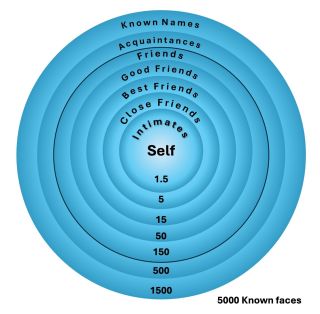
Dunbar says “The typical human personal social network contains about 150 relationships including kin, friends, and acquaintances, organized into a set of hierarchically inclusive layers of increasing size but decreasing emotional intensity” (Tamarita, Cuesta, Dunbar, and Sanchez, 2018). That maximum group size is remarkably consistent across cultures and modes of communication ranging from phone contact, through social media (Dunbar, 2018).
At the very heart of our social networks are our strongest and most intimate relationships, our best friends, or the friends we’ve had since childhood. This group is usually quite small, perhaps 3 to 5 other people. These are the friends that know us the best, who know what’s happening in our lives, and the ones we turn to for support, sympathy, and advice. Moving to the increasingly larger outer rings of our social networks are work friends, casual friends, and acquaintances. Our interactions with these people tend to be less frequent than with our inner circle of friends, and usually we have much less emotion invested in them. Way out on the outermost circle, we may have difficulty matching a face with a name, and our social investment is minimal. These are not the people we would turn to for support.
These circles of relationships are not static, with people moving in and out of all of our network circles, even the innermost ones. We work to keep these close friends, because having friends makes us happier and healthier, and helps us live longer (Dunbar, 2018).
Dunbar’s Number may have a biological base. Dunbar speculated that the size of our social network depended on the volume of our neocortex because cortical size is related to cognitive ability. He noted that larger cortices tended to be found in primates that formed larger social groups. Larger social groups require more cognitive skill, but just as brain size is ultimately limited so is maximum group size. Go beyond 150, and we don’t have the cognitive capacity, the time, attention or the energy needed to effectively maintain those relationships (Dunbar, 1992).
So, has social media changed how we think about friends? Psychologists define friendship as “A voluntary relationship between two or more people that is relatively long-lasting and in which those involved tend to be concerned with meeting the others’ needs and interests as well as satisfying their own desires” (American Psychological Association, n.d.). Developing friendships requires shared experience and it is here that the limits of social media friends become apparent. The way we share with our friends when we meet them in real life is different than the way we meet them, and interact with them, online.

Dunbar asserts that social media has been wildly successful in many ways because “it allows you to keep track of people who would otherwise effectively disappear… But one of the things that keeps face-to-face friendships strong is the nature of the shared experience.” We can share and like posts on social media, but Dunbar says these interactions lack the “synchronicity of shared experience.” Watch a movie by yourself and your reactions alone won’t be the same as they would be when watching with your friends. (Konnikova, 2014).
Social media allows us to connect with everyone, everywhere and all the time. One might then expect that Dunbar’s number would be getting bigger. This is not what the research shows. For example, Goncalves, Perra and Vespignani (2011) examined 380 million Twitter posts made by 1.7 million people across six months. They found that Twitter users were able to maintain between 100 and 200 stable relationships – the middle of that range is Dunbar’s number of 150. And in a 2013 study of Facebook friend networks from “more than 1 million” users found that Dunbar’s number still holds. The median friend network size was 342 – the upper edge of Dunbar’s number, but still within range (Wolfram, 2013).
Interestingly, research has also shown that, compared to having no friends at all, even weak friendships support our physical and mental health (Sandstrom and Dunn, 2022).
Social media has made maintenance of our friendships with all the circles of our social network easier but has likely not really changed the meaning of what it is to be someone’s friend. The people we call on for support and sympathy may be the inner circle friends we made on the schoolyard, more than the folks we met online.
References
Dunbar, R.I.M. (1992). Neocortex size as a constraint on group size in primates. Journal of Human Evolution, 20, 469-493.
Dunbar, R.I.M. (2016) Do online social media cut through the constraints that limit the size of offline social networks? Royal Society Open Science, 3, 150292.
Dunbar, R.I.M. (2018). The Anatomy of Friendship. Trends in Cognitive Sciences, 22 (1), 32-51.
Goncalves B., Perra N., and Vespignani, A. (2011) Modeling users’ activity on twitter networks: Validation of Dunbar’s Number. PLoS ONE 6(8): e22656.
Konnikova, M. (2014). The Limits of Friendship. The New Yorker, https://www.newyorker.com/science/maria-konnikova/social-media-affect-m…
Sandstrom, G.M., and Dunn, E.W. (2014). Social interactions and well-being: The surprising power of weak ties, Personality and Social Psychology Bulletin, 40(7), 910-922.
Tamarita, I., Cuesta, J.A., Dunbar, R.I.M., and Sanchez, A. (2018) Cognitive resource allocation determines the organization of personal networks, PNAS, 115(33), 8316-8321.
Wolfram, S. (2013) Data Science of the Facebook World. http:// blog.stephenwolfram.com/2013/04/ data-science-of-the-facebook-world/