Verified by
Child Development
How To Make Your Child a Psychological Wreck - The Playground Manual
You can screw your kid up at the playground too!
Posted January 8, 2010


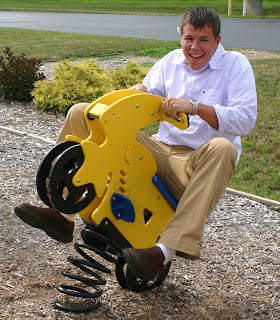 Push the kid the whole way to the playground in their stroller. "I have to - otherwise they'll run out in the street."
Well, you're getting them ready to be adults who try to park as close to the entrance door to their health club as possible, to avoid extra walking. You know, walking is exercise - as well as generally good prep for life self-management. Everyone has to learn how to do it at some point.
Inordinately praise what kids do naturally and joyously. "You are such a big girl, going down that slide all by yourself. I am SO proud of you."
This represents a kind of naïve self-esteem psychology - that you should let children know that you appreciate when they do something well. In fact, this praise injects you into the child's psychologically crucial inner world of self-appreciation and enjoyment. And being able to appreciate and savor alone moments is what happiness psychology is all about.
Express your anxieties without restraint. "Can he get down from there on his own? I'm afraid she'll fall."
You're not aware that young people are often tremendously anxious and incapable of doing things for themselves? If you aren't, it's because young kids have a certain joie de vivre that scares you, and that you want to beat out of them so that they will become medication-gulping adolescents.
Act like the child is in imminent danger at all times. "I'll just stand by him so he or she doesn't fall, or in case she needs help. And I'll just guide him down the slide."
This wipes out self-reliance and self-confidence, while convincing the child both that the world is a dangerous place, and that he or she is incapable of dealing with it unassisted. I mean, they build playgrounds to present mild, safe challenges, and kids have a natural propensity both to (a) stay within their limits, (b) incrementally extend these limits. Go on, foul that up, why don't you?
Interfere with child's relationship with other kids. "Johnny, give that ball back to the little girl. Don't play with her toys."
Remember that kids play with kids? Been doing it for centuries? They don't need parents to act as directors, with the children playing scripted roles you've determined, due to the wisdom of your years, they need to fulfill. Of course, if you screw their ability to do this for theselves up, then you can take them to a child psychologist who can help them by using - er - play therapy.
Interrupt play with food. "Jill, are you hungry? Here, I brought some chips" (or, if you're already reading child-rearing manuals, carrot sticks).
The greatest gift children can have, along with self-direction, is being able to devote themselves to activities whole-heartedly, and then to asess their needs, like determining when they are hungry and eating when they recognize that they are. Failing to learn this guarantees a lifetime of self-recrimination, therapy, and medications.
P.S. Works for the beach also